A good beginner gym workout plan is three full body workouts a week, on non-consecutive days like Monday, Wednesday and Friday. You alternate between two workouts, A and B, with five exercises each. Each workout takes about 45 to 60 minutes, and the plan works the same way for men and women.
Full body training is a great place to start because you practice the main lifts often and train every muscle more than once a week. It also matches what the American College of Sports Medicine recommends for beginners: 2 to 3 full body workouts a week, with 1 to 3 sets of 8 to 12 reps per exercise.
The plan
Workout A
| Exercise | Sets × reps | Machine option |
|---|---|---|
| Goblet squat | 3 × 8 to 12 | Leg press |
| Dumbbell bench press | 3 × 8 to 12 | Chest press machine |
| Lat pulldown | 3 × 8 to 12 | Assisted pull-up machine |
| Dumbbell Romanian deadlift | 2 × 10 to 12 | Seated leg curl |
| Plank | 2 × 20 to 30 seconds | Cable crunch |
Workout B
| Exercise | Sets × reps | Machine option |
|---|---|---|
| Leg press | 3 × 10 to 12 | Hack squat |
| Seated cable row | 3 × 8 to 12 | Chest-supported row machine |
| Dumbbell shoulder press | 3 × 8 to 12 | Shoulder press machine |
| Walking lunges | 2 × 10 per leg | Leg extension |
| Dumbbell curl and triceps pushdown | 2 × 10 to 12 each | Cable curl |
The machine options in the table work as well as the free weight exercises. If a free weight exercise feels awkward or the equipment you want is taken, you can use the machine option and keep going.
Your weekly schedule
Alternate the workouts, so you do A twice one week and B twice the next:
| Week | Monday | Wednesday | Friday |
|---|---|---|---|
| Week 1 | A | B | A |
| Week 2 | B | A | B |
Any three days work, as long as you leave a day between workouts. If you can only make it twice in a week, do A and B and carry on from there.
How to do each workout
- Warm up for 5 to 10 minutes. A few minutes on the bike or treadmill, then one or two light sets of your first exercise.
- Leave 2 to 3 reps in the tank. End each set when you could have done 2 or 3 more good reps. For more on that, see What does RIR mean in lifting?
- Rest about 1.5 to 2 minutes between sets. Rest a little longer on squats and presses if you're still catching your breath. See How long to rest between sets.
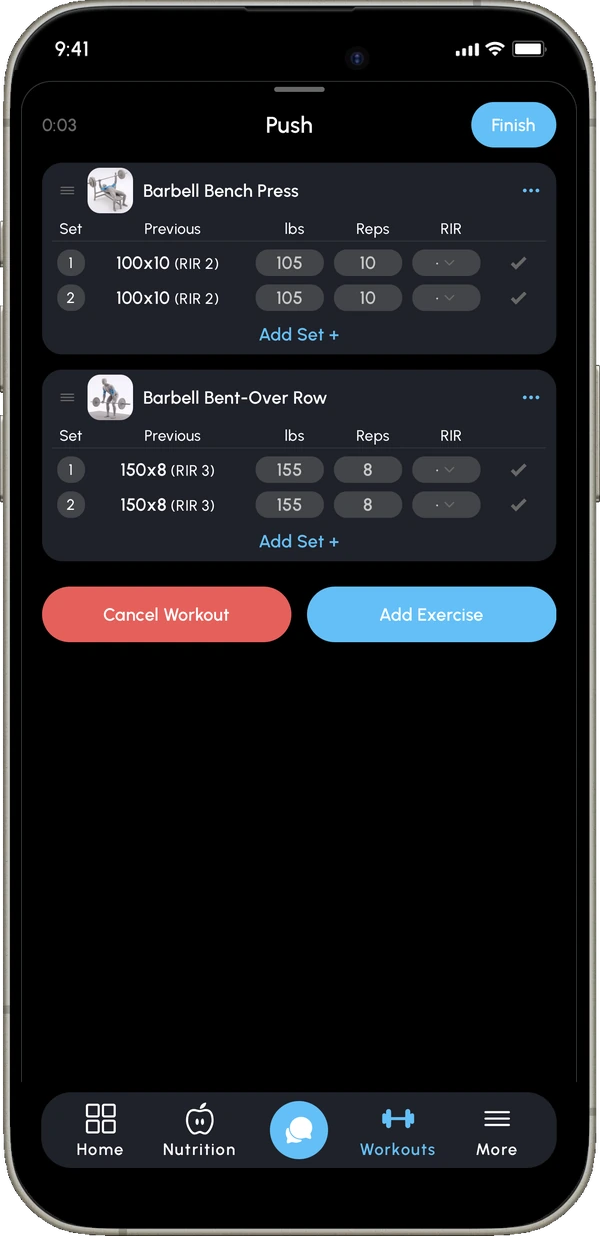
- Write it all down. Log the weight, reps and how hard each set felt, so you know what to beat next time.
How to pick your starting weights
Start lighter than you think. In your first week, pick a weight you can lift for 12 reps with good form and a few reps to spare. The first week can feel easy while you're learning the movements, and you'll add weight quickly.
If all 12 reps feel easy on every set, go up a little next time. If you can't reach 8 reps, drop the weight.
How to progress
Use a method called double progression. Keep the same weight and add reps each workout until you hit the top of the rep range on every set. Then add a little weight, drop back to the bottom of the range and build up again.
For example, if you do 3 sets of 8 on the leg press at 140 lb (64 kg), aim for 9s next time, then 10s, 11s and 12s. Once you get 3 sets of 12, move to 150 lb (68 kg) and start again at 8. For more, see Progressive overload, explained.
As a beginner, you can often add weight every week or two for months. Progress slows after your first year or so, so these early gains come faster than later ones.
What to expect
- Weeks 1 to 2: some muscle soreness a day or two after your workouts is normal, and it fades as your body gets used to training.
- Weeks 2 to 8: your strength goes up fast, mostly because you're getting better at each movement.
- Months 2 to 3 and beyond: you start to see and feel more muscle, especially if you're eating enough protein. See How much protein do I need a day?
The U.S. Physical Activity Guidelines recommend strength training for all major muscle groups at least 2 days a week, plus at least 150 minutes of moderate cardio like brisk walking. This plan covers the strength part. A few walks a week covers the rest, and our walking plan example builds up your steps a little at a time.
Tips for your first few weeks
- Go at quieter times. Mid-morning, early afternoon and late evening are usually less busy, so the machines you want are free.
- Ask for help with machines. Gym staff are usually happy to show you how to set the seat and pads. Take a photo of the settings so you remember them next time.
- Bring your plan with you. Knowing what you're doing next keeps you moving and makes the gym feel a lot less intimidating.
- Focus on form first. If you use a lighter weight and slow, controlled reps, you'll learn the movement and stay safe.
- Look up words you don't know. Our Fitness Dictionary explains more than 180 gym and nutrition terms in plain English, from AMRAP to TDEE.
When to change your plan
You can keep progressing on a plan like this for at least 3 to 6 months. When your progress slows down even though you're sleeping and eating well, or you want to train 4 or more days a week, it's a good time to try a new split. See Push pull legs vs upper lower vs full body. Our Routine Finder can also match you with a weekly routine example for the days you have.


Common questions
Is this plan good for women?
Yes. Men and women build muscle and strength the same way, so the plan, the sets and reps and the way you progress are all the same. Only the starting weights differ from person to person.
Can I do this plan at home?
Yes, with a pair of adjustable dumbbells and a bench. Swap the leg press for goblet squats, the lat pulldown and cable row for dumbbell rows, and the triceps pushdown for overhead dumbbell extensions.
How long until I see results?
Most people feel stronger within the first two to three weeks. Visible changes usually take two to three months of training consistently and eating enough protein.
Do I need supplements?
No. Getting enough protein and calories from food matters far more. A protein powder can make it easier to hit your protein target, but it's optional.
Do I do cardio before or after lifting?
After lifting, or on separate days, so your legs are fresh for squats and lunges. A short 5 to 10 minute warm-up on the bike or treadmill before you lift is fine.
What if I miss a workout?
Pick up where you left off. If you missed workout B, do B next time. One missed workout won't set you back.
Sources
- American College of Sports Medicine. Position stand: progression models in resistance training for healthy adults. Medicine and Science in Sports and Exercise (2009).
- U.S. Department of Health and Human Services. Physical Activity Guidelines for Americans, 2nd edition (2018).
- Schoenfeld B.J. et al. Effects of resistance training frequency on measures of muscle hypertrophy: a systematic review and meta-analysis. Sports Medicine (2016).