For most lifting, rest about 2 to 3 minutes between sets of compound lifts like squats, deadlifts and bench press, and about 1 to 2 minutes between sets of isolation exercises like curls and lateral raises. If your goal is maximum strength, resting 3 to 5 minutes on your heaviest lifts can help even more.
It's easy to rest too little, because short rest feels harder, and harder feels like it's working. For building muscle and strength, researchers have found the opposite: resting long enough to do your next set well usually gets you better results.
Rest times by goal
| Goal | Compound lifts | Isolation exercises |
|---|---|---|
| Building muscle | 2 to 3 minutes | 1 to 2 minutes |
| Getting stronger | 3 to 5 minutes | 1.5 to 2 minutes |
| Beginners | 1.5 to 2 minutes | About 1 minute |
| Muscular endurance | 30 to 90 seconds | 30 to 60 seconds |
The American College of Sports Medicine recommends at least 2 to 3 minutes of rest for compound lifts done with heavier weights, and 1 to 2 minutes for other exercises. Beginners lifting lighter weights can usually get by with a bit less.
How long to rest for muscle growth
For a long time, short rest of 30 to 60 seconds was the standard advice for building muscle. More recent studies haven't backed that up.
In a 2016 study, experienced lifters who rested 3 minutes between sets gained more strength and built more muscle in some areas than lifters who rested 1 minute, even though both groups did the same workouts. A 2024 review that pooled the rest period research found a small benefit to resting longer than about 60 seconds, with little extra benefit past about 90 seconds.
When you rest longer, you can do more reps on your next set, so you get more total work out of each workout. Short rest makes the next set feel harder, but you usually end up lifting less.
| Bench press at 185 lb (84 kg) | Set 1 | Set 2 | Set 3 | Total reps |
|---|---|---|---|---|
| 1 minute of rest | 10 | 7 | 6 | 23 |
| 3 minutes of rest | 10 | 9 | 8 | 27 |
The numbers above are an example, but the pattern is typical: with more rest, you get more good reps out of the same weight.
How long to rest for strength
When you're lifting heavy, close to your max, your muscles need more time to recover their short-term energy before the next set. A review of the research on rest and strength found that resting more than 2 minutes led to bigger strength gains in people with lifting experience. For your heaviest sets of 1 to 5 reps, 3 to 5 minutes is common.
How long to rest for weight loss
Shorter rest keeps your heart rate up, but it doesn't burn enough extra calories to make a real difference in fat loss. What you eat matters much more. For more on that, see How to count calories to lose weight.
When you're losing weight, lifting heavy enough to keep your muscle is the main goal of your workouts. Resting long enough to keep your sets strong helps with that. If time is tight, use the time-saving tips below instead of cutting your rest short.
Rest times by exercise
Bigger exercises that use more muscle need more rest. Smaller exercises recover faster:
| Exercise | Rest between sets |
|---|---|
| Squat and deadlift | 2 to 3 minutes, or 3 to 5 for heavy sets |
| Bench press and overhead press | 2 to 3 minutes |
| Rows, pulldowns and pull-ups | About 2 minutes |
| Leg press and lunges | About 2 minutes |
| Curls, triceps and lateral raises | 1 to 1.5 minutes |
| Calf raises and abs | About 1 minute |
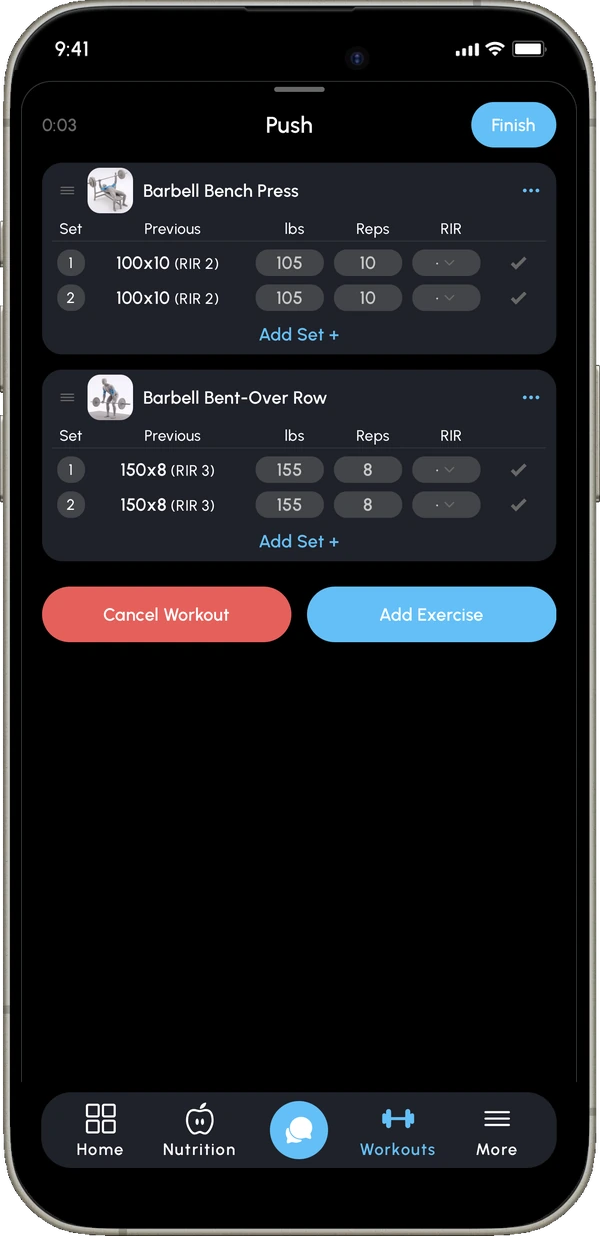
Our workout routine examples follow the same pattern, with a rest time listed for every exercise.
How to save time without cutting rest
- Pair exercises. Alternate two exercises that use different muscles, like a set of bench press, then a set of rows. Each muscle still gets a few minutes of rest, but you're working the whole time.
- Use shorter rest on small exercises. Curls, lateral raises and calf raises recover quickly, so 60 to 90 seconds is usually plenty.
- Cut a set instead of cutting rest. Two good sets often do more than three rushed ones.
How to tell you're ready for the next set
Rest times are a guide. A simple check is your breathing: once it's back to normal and you feel ready to give the next set a full effort, go. If your reps drop off a lot from one set to the next, rest a little longer next time.
If you track your reps and how hard each set felt, you'll see whether your rest is working. If your second and third sets keep falling well short of your first, more rest will probably help.


Common questions
Is 30 seconds of rest enough?
For light endurance work or bodyweight circuits, yes. For building muscle or strength with challenging weights, 30 seconds usually isn't enough to recover, and you'll get fewer reps on your later sets.
How long to rest between sets of push-ups?
About 1 to 2 minutes if you're taking each set close to failure. If you're doing easier sets to build up your total reps, 30 to 60 seconds works.
How long to rest between sets of bench press?
About 2 to 3 minutes for most sets, and 3 to 5 minutes if you're doing heavy sets of 5 reps or fewer.
Can I rest too long?
It takes a long rest before it hurts your next set. The main downside is that your workouts take longer. Past about 5 minutes, most people don't gain much from extra rest.
Do I rest between the two exercises in a superset?
Only long enough to move from one exercise to the next. Then rest about 1.5 to 2 minutes after you finish both, before you start the next round.
Does rest time matter for beginners?
Less than it does for experienced lifters. When you're new, your weights are lighter and you recover faster, so 1.5 to 2 minutes on most exercises is plenty. Focus on learning the movements and showing up consistently.
Is it OK to check my phone between sets?
Sure, as long as it doesn't turn a 2-minute rest into 6 minutes. Setting a timer on your phone or watch keeps your rest about the same from set to set, which makes it easier to compare one week's workouts with the next.
How long to rest between exercises?
About the same as between sets, around 2 to 3 minutes. Use the time to set up your next exercise and do a quick warm-up set if it's a big lift.
Sources
- American College of Sports Medicine. Position stand: progression models in resistance training for healthy adults. Medicine and Science in Sports and Exercise (2009).
- Schoenfeld B.J. et al. Longer interset rest periods enhance muscle strength and hypertrophy in resistance-trained men. Journal of Strength and Conditioning Research (2016).
- Singer A. et al. Give it a rest: a systematic review with Bayesian meta-analysis on the effect of inter-set rest interval duration on muscle hypertrophy. Frontiers in Sports and Active Living (2024).
- Grgic J. et al. Effects of rest interval duration in resistance training on measures of muscular strength: a systematic review. Sports Medicine (2018).