The best workout split is the one that fits how many days a week you can train. Full body works best for 2 or 3 days a week, upper lower fits 4 days, and push pull legs works for 3 or 6 days. When the total amount of work is the same, studies find they all build about the same amount of muscle.
Start with your schedule. Pick the split that matches the days you can get to the gym most weeks. You'll get more out of it than a "better" split you keep missing days on.
What is a workout split?
A split is how you divide your training across the week. Some splits train your whole body every session. Others give each day a focus, like upper body one day and legs the next. Your split sets how often each muscle gets trained and how long each workout takes.
Full body
With a full body split, every workout hits all your major muscles: usually a leg exercise, a push, a pull and a couple of accessory exercises. You train each muscle every session, so with three workouts a week, each muscle gets trained three times.
| Day | Workout |
|---|---|
| Monday | Full body A: squat, bench press, row, curls |
| Wednesday | Full body B: deadlift, overhead press, pulldown, lunges |
| Friday | Full body A again |
Good for: beginners, busy people training 2 or 3 days a week, and anyone whose schedule changes a lot. If you miss a day, you've still trained every muscle that week.
The downside: each workout covers a lot of ground, so sessions can run long, and there's less room to add extra sets for one muscle.
Upper lower
An upper lower split alternates upper body days (chest, back, shoulders and arms) with lower body days (quads, hamstrings, glutes and calves). Over four days, each muscle gets trained twice a week.
| Day | Workout |
|---|---|
| Monday | Upper: bench press, row, overhead press, pulldown, curls |
| Tuesday | Lower: squat, Romanian deadlift, leg press, calf raises |
| Thursday | Upper: incline press, pull-ups, lateral raises, triceps |
| Friday | Lower: deadlift, lunges, leg curls, calf raises |
Good for: people who can train 4 days a week and want a step up from full body. It's a popular choice once you're past your first few months of lifting.
The downside: upper body days can feel crowded, since chest, back, shoulders and arms all share one workout.
Push pull legs
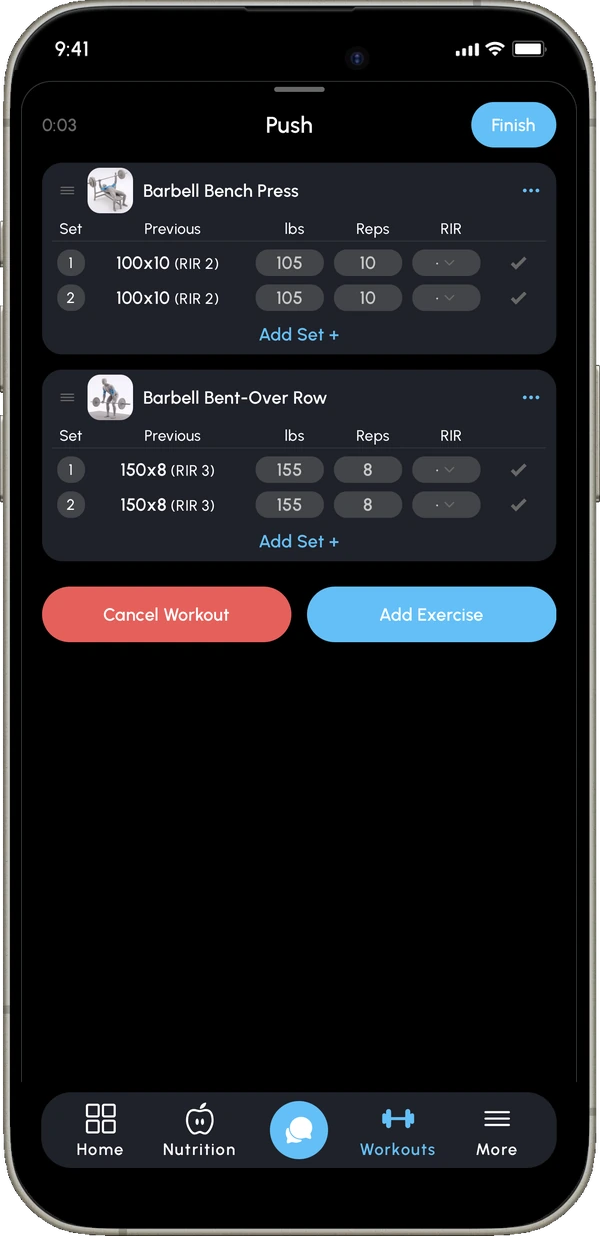
Push pull legs, often shortened to PPL, splits your training by movement:
- Push day covers chest, shoulders and triceps, with exercises like bench press, overhead press and dips.
- Pull day covers back and biceps, with rows, pull-ups, pulldowns and curls.
- Leg day covers quads, hamstrings, glutes and calves, with squats, deadlifts, lunges and leg curls.
You can run it two ways. On 3 days a week, you do each day once, so each muscle gets trained once a week. On 6 days a week, you go through the cycle twice, so each muscle gets trained twice.
| Day | 3-day PPL | 6-day PPL |
|---|---|---|
| Monday | Push | Push |
| Tuesday | Rest | Pull |
| Wednesday | Pull | Legs |
| Thursday | Rest | Push |
| Friday | Legs | Pull |
| Saturday | Rest | Legs |
Good for: people who like to train often and want shorter, focused workouts. It's easy to follow, because each day has a clear job.
The downside: six days a week is a big commitment, and the 3-day version only trains each muscle once a week.
What the research says
A 2016 review found that training each muscle at least twice a week built more muscle than training it once a week. A later review by the same group looked at studies where people did the same total number of sets, spread differently, and found that how often you trained each muscle made little difference.
A 2024 review that compared split routines directly with full body training found no meaningful difference in muscle growth or strength between the two. Taken together, these reviews suggest the total amount of hard work you do for each muscle over the week matters most, and your split is how you fit that work into your schedule.
In practice, hitting each muscle about twice a week is an easy way to fit in enough sets without making any one workout too long. Full body, upper lower and 6-day PPL all do that. For how many sets to aim for, see How many sets per week to build muscle?
How to pick your split
| Days you can train | Good fit | Each muscle trained |
|---|---|---|
| 2 | Full body | 2 times a week |
| 3 | Full body, or 3-day PPL | 3 times, or once |
| 4 | Upper lower | 2 times a week |
| 5 | Upper lower plus a full body day, or PPL plus upper lower | About 2 times a week |
| 6 | 6-day PPL | 2 times a week |
A few more things to think about:
- Be honest about your schedule. You'll make more progress on a 3-day plan you finish every week than on a 6-day plan you only half finish.
- New to lifting? Full body is a great place to start. You get lots of practice on the main lifts, and it's forgiving when you miss a day. For a ready-made plan, see Beginner gym workout plan.
- Pick one you enjoy. You're far more likely to keep showing up for a plan you like, and consistency matters more than the split.
- Stick with it. Give a split at least 8 to 12 weeks before you judge it, and keep adding weight or reps as you go. For how to do that, see Progressive overload, explained.
To see which of our routine examples fits your week, try our Routine Finder.
What about a bro split?
A "bro split" gives each muscle its own day, like chest on Monday, back on Tuesday and so on, so each muscle only gets trained once a week. It can work if you do plenty of sets on each day, but most people get more out of a split that trains each muscle twice a week.


Common questions
Is push pull legs good for beginners?
It can be, especially the 3-day version, but most beginners do better with full body. You practice the main lifts more often, and each muscle gets trained more than once a week.
Is upper lower or push pull legs better for muscle growth?
Neither one wins on its own. When the weekly sets for each muscle are about the same, both build muscle at a similar rate. A 4-day upper lower and a 6-day PPL both train each muscle twice a week, so pick the one that fits your schedule.
Can I switch splits?
Yes. You can start with full body, move to upper lower after a few months, and try PPL later when you have more time to train. Give each one a couple of months before you switch.
Do I train abs on a specific day?
You can add a couple of ab exercises to the end of any two or three workouts a week. They recover quickly, so they fit into any split. For a full session, see our core workout example.
Sources
- Schoenfeld B.J. et al. Effects of resistance training frequency on measures of muscle hypertrophy: a systematic review and meta-analysis. Sports Medicine (2016).
- Schoenfeld B.J. et al. How many times per week should a muscle be trained to maximize muscle hypertrophy? A systematic review and meta-analysis of studies examining the effects of resistance training frequency. Journal of Sports Sciences (2019).
- Ramos-Campo D.J. et al. Efficacy of split versus full-body resistance training on strength and muscle growth: a systematic review with meta-analysis. Journal of Strength and Conditioning Research (2024).
- Schoenfeld B.J. et al. Dose-response relationship between weekly resistance training volume and increases in muscle mass: a systematic review and meta-analysis. Journal of Sports Sciences (2017).