This 8-week walking plan builds up your daily steps a little at a time. It starts around 5,000 steps a day. If you already walk more than that, you can start from your own average and add about 1,000 steps every two weeks.
Workout Routine Examples



Track macros and calories
8-Week Walking Plan Example
Building up your daily steps over 8 weeks.
| Weeks | Steps a day | What it can look like |
|---|---|---|
| Weeks 1 and 2 | About 5,000 | Your normal day plus one 10-minute walk |
| Weeks 3 and 4 | About 6,000 | Two 10-minute walks, like after lunch and after dinner |
| Weeks 5 and 6 | About 7,000 | Two 15-minute walks |
| Weeks 7 and 8 | 8,000 or more | A 30-minute walk, or a few shorter ones |
This is an example, not a prescription or medical advice. If you have an injury, a heart condition or another health condition, check with your doctor before starting a new exercise routine.
Need an app to track your progress?
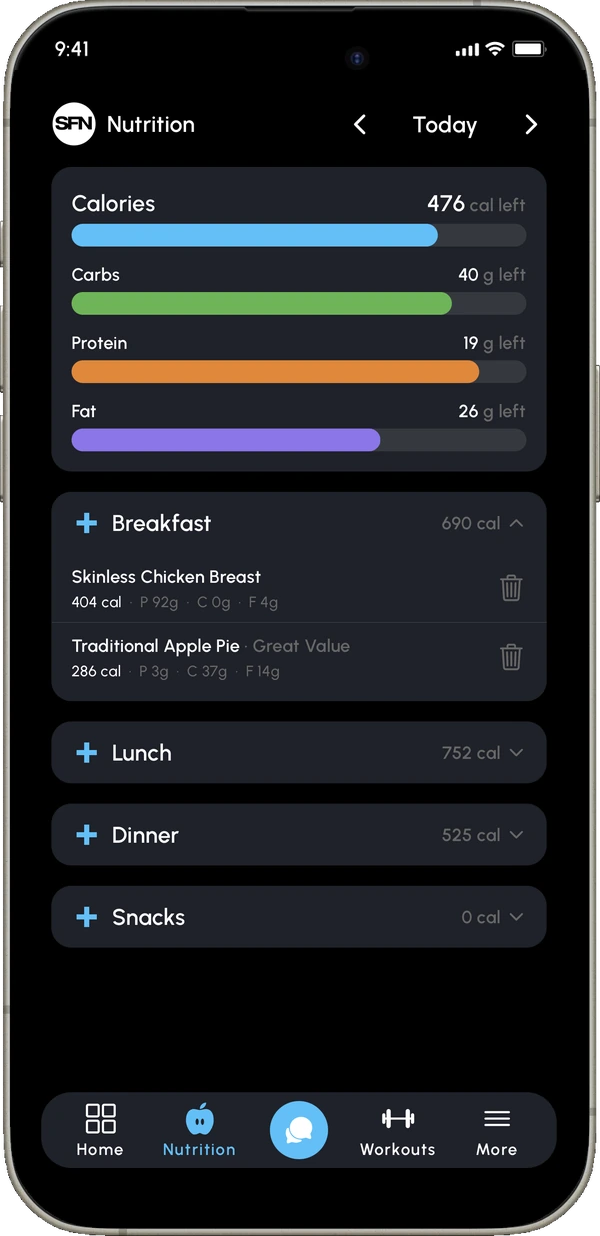
Somatics keeps your calories, carbs, protein and fat in one place, so you can see how close you are to your targets every day.
Who is this for?
This example can work well for you if:
- you walk fewer than about 5,000 steps a day and want to build up
- you'd like a low-impact way to move more, with or without lifting
- you have a phone or watch that counts your steps
Once 8,000 steps feels normal, the incline walk workout adds a harder walk to your week. For a week that mixes walking with lifting, see the cardio and lifting week example. For how steps help with weight loss, see How many steps a day to lose weight?
About this example
For many people, a mile is about 2,000 steps, so 1,000 extra steps is around a 10-minute walk.
A 2022 study that pooled data from 15 groups of adults found that more daily steps went with a lower risk of dying early, up to a point. The benefit leveled off at about 6,000 to 8,000 steps a day for adults 60 and older, and 8,000 to 10,000 for younger adults. With that in mind, this example aims for 8,000 or more and skips a strict 10,000 target.
Walking adds to the calories you burn in a day without making you as hungry or as tired as a hard workout, so it pairs well with lifting when you're losing fat.
Common questions
Can I split my steps into shorter walks?
Yes. Several short walks add up the same way. A walk after meals is an easy habit to start with.
Does walking count as cardio?
Brisk walking counts as moderate cardio. The U.S. guidelines suggest 150 to 300 minutes of moderate activity a week, and a brisk 30-minute walk five days a week covers 150.
What if I miss my steps one day?
One low day makes little difference. Your weekly average gives a truer picture than any single day, so you can pick it back up tomorrow.
Sources
Track macros and calories
with Somatics