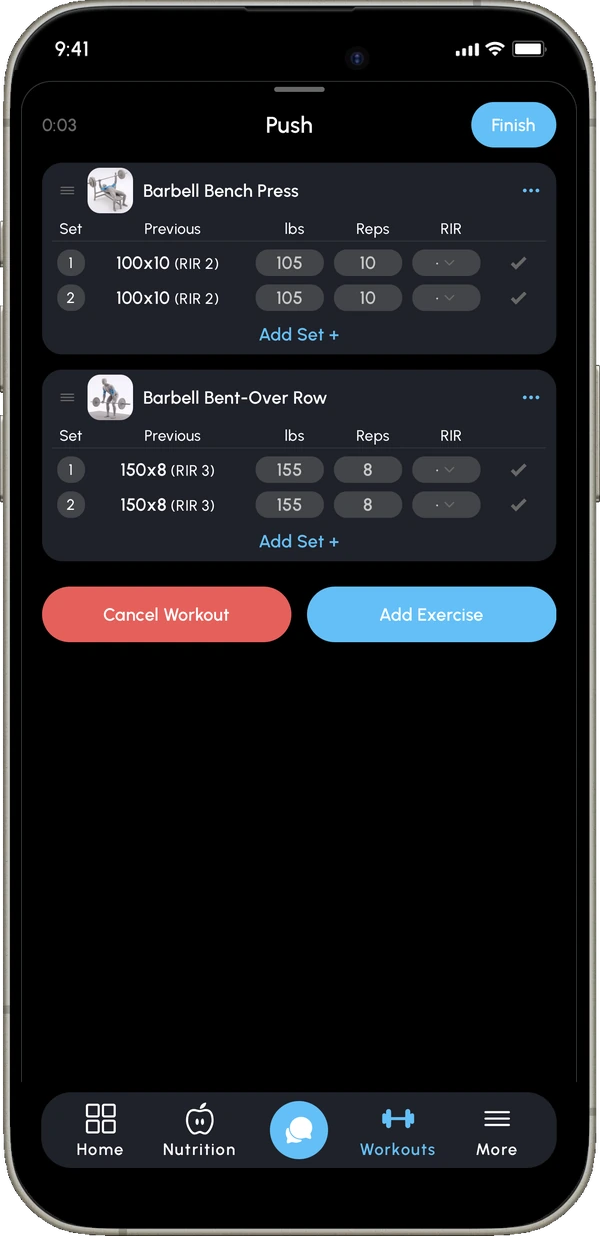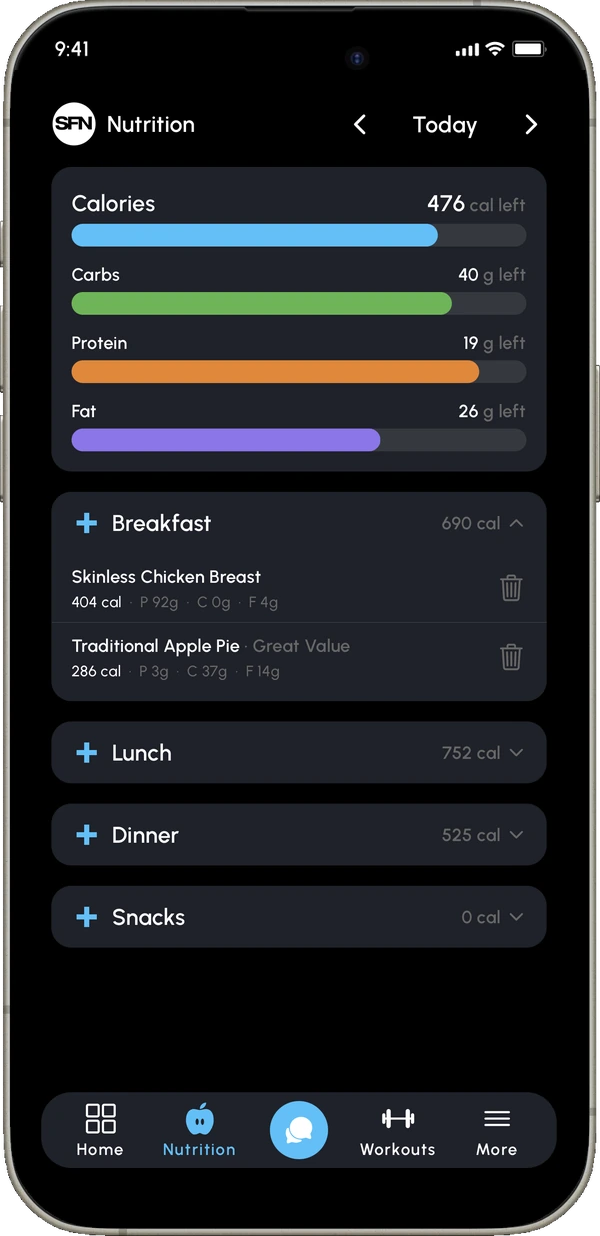
RIR stands for reps in reserve, which is how many more reps you could have done at the end of a set with good form. If you finish a set of 8 and could have done 2 more, that set was 2 RIR. If you couldn't have done another rep, it was 0 RIR.
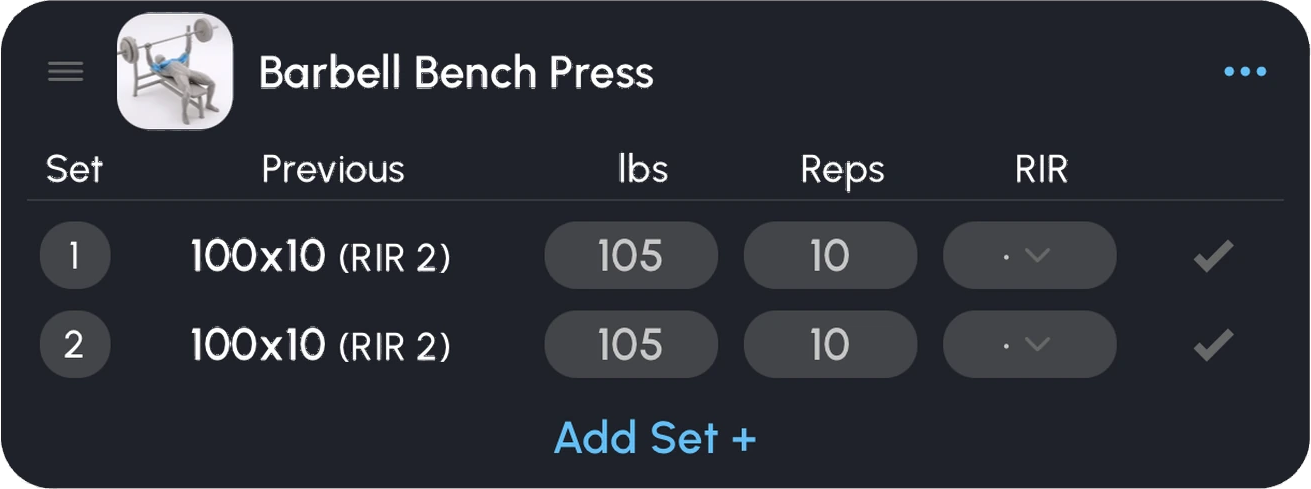
Instead of "that felt hard," you get a number you can write down, compare week to week and use to decide when to add weight.
The RIR scale
You'll often see RIR next to RPE, or rating of perceived exertion, which scores effort from 1 to 10. They measure the same thing from opposite ends. RPE 10 means you had nothing left, which is the same as 0 RIR.
| RIR | RPE | How the set feels |
|---|---|---|
| 0 | 10 | You couldn't do another rep |
| 1 | 9 | Maybe one more, and it would be a grind |
| 2 | 8 | Hard, with two good reps left |
| 3 | 7 | Tough, but the bar is still moving well |
| 4 or more | 6 or less | Comfortable, like a warm-up |
How to rate a set
- Rate it right after your last rep, while you still remember how it felt.
- Only count reps you could have done with good form. If your form would have broken down, that rep wasn't in reserve.
- Watch how fast the bar moves. When your reps slow down a lot, you're one or two reps from failure in most cases.
- Be honest with yourself. RIR only helps if your number matches what happened.
You'll get better at it with practice. A review of studies found that people tend to think they have about one rep fewer left than they do, and that their guesses are more accurate on sets that end close to failure. Taking a set to true failure every few weeks, on an exercise where that's safe, is a good way to check yourself.
Why lifters use RIR
You can compare effort from week to week. Ten reps at 2 RIR this week and ten reps at 2 RIR next week are the same effort, even if you slept or ate differently.
It adjusts to how you feel that day. On a good day you might hit 2 RIR with 185 lb (84 kg). On a tired day you might hit it at 175 lb (79 kg). Training by RIR keeps the effort right without locking you into one weight.
It helps you manage fatigue. Taking every set to failure wears you down fast. Leaving a rep or two in the tank lets you do more good sets over the week.
It shows progress early. Before you add weight, you'll often notice the same weight feeling easier. If 155 lb (70 kg) goes from 2 RIR to 3 RIR, you're getting stronger, weeks before you set a new personal best.
How many reps in reserve to leave
To build muscle, most of your working sets can end between 0 and 3 RIR. A 2023 review found that muscle growth improves as sets get closer to failure, while strength gains don't depend on it as much. In practice:
- Big lifts like squats, deadlifts and bench press: 1 to 3 RIR, because failing a heavy rep is riskier.
- Machines and smaller exercises like curls, lateral raises and leg extensions: 0 to 2 RIR, since pushing close to failure is low risk.
- Your last set of an exercise is a good place to push a little harder than the sets before it.
You can see these ranges in action in our workout routine examples, which list a target RIR for every exercise.
RIR vs training by percentages
Many programs give weights as a percentage of your one-rep max, like 5 sets of 5 at 75%. That works when your max is up to date and you're having a normal day. RIR covers the days when that isn't true: your max is three months old, you slept badly, or you've gotten stronger faster than the program expected. You can use both, with percentages to pick a starting weight and RIR to adjust it on the day.
RIR also works if you've never tested your one-rep max, which is true for most people who lift for health and muscle rather than competition. A target like 8 reps at 2 RIR works with any weight, on any day.
Using RIR to decide when to add weight
One simple way to do this is a method called double progression. Pick a rep range and an RIR, for example 8 to 10 reps at 2 RIR. Add a rep each session until you hit the top of the range at that effort, then add weight and start again at the bottom.
| Week | Bench press | RIR | Next step |
|---|---|---|---|
| 1 | 155 lb (70 kg) × 8 | 2 | Add a rep |
| 2 | 155 lb (70 kg) × 9 | 2 | Add a rep |
| 3 | 155 lb (70 kg) × 10 | 2 | Top of the range: add weight |
| 4 | 160 lb (72.5 kg) × 8 | 2 | Build reps again |
If a set ends with more reps in reserve than you planned, you can add weight sooner. If you hit 0 RIR when you were aiming for 2, stay at that weight and build back up.


Common mistakes
- Sandbagging. If you call a set 3 RIR when you had 6 more reps in you, you'll train too light for weeks.
- Counting sloppy reps. If your form would have broken down, that rep doesn't count as one you had left.
- Rating warm-ups. RIR is for your working sets. Warm-ups are supposed to feel easy.
- Comparing different exercises. 2 RIR on a squat feels different from 2 RIR on a curl. Compare each lift to itself over time.
Common questions
Is RIR the same as RPE?
They measure the same effort from opposite ends. RPE 8 is about 2 reps in reserve, RPE 9 is about 1, and RPE 10 is none.
Is training to failure bad?
Not on its own. Going to failure now and then is fine, especially on safer exercises, and it helps you calibrate your RIR. Taking every set of your heavy lifts to failure builds up a lot of fatigue without much extra benefit.
Can beginners use RIR?
Yes. New lifters often misjudge how much they have left, so aiming for 2 to 3 RIR gives you some room for error while your form and judgment improve.
Do I track RIR on every set?
Tracking it on your working sets is enough, and you can skip warm-ups. If you'd rather keep it shorter, you can rate only the last set of each exercise, which still shows whether the weight is ready to go up.
How accurate is RIR?
It's accurate enough to be useful, and you get better at it with practice. Most people land within one or two reps, and they're most accurate on sets that end close to failure.
Sources
- Zourdos M.C. et al. Novel resistance training-specific rating of perceived exertion scale measuring repetitions in reserve. Journal of Strength and Conditioning Research (2016).
- Helms E.R. et al. Application of the repetitions in reserve-based rating of perceived exertion scale for resistance training. Strength and Conditioning Journal (2016).
- Halperin I. et al. Accuracy in predicting repetitions to task failure in resistance exercise: a scoping review and exploratory meta-analysis. Sports Medicine (2022).
- Refalo M.C. et al. Influence of resistance training proximity-to-failure on skeletal muscle hypertrophy: a systematic review with meta-analysis. Sports Medicine (2023).