Progressive overload means making your workouts a little harder over time by adding weight, reps, sets or effort. Your muscles adapt to what you ask of them. Once a workout stops being a challenge, it stops making you stronger, so you keep raising the bar in small steps.
Coaches build good strength programs around this idea. The details change from program to program, but if your training isn't slowly getting harder, your progress will stall.
Why it works
When you lift something heavy enough for enough reps, your body responds by building more muscle and getting better at using the muscle you have. Once it has adapted, the same workout isn't enough to push it further. Progressive overload keeps your body adapting by making each stretch of training a little harder than the last.
Ways to add overload
Adding weight is the obvious one, but you have several options:
- More weight. You do the same sets and reps with a heavier load.
- More reps. You keep the same weight and do an extra rep or two.
- More sets. You add a set, so that muscle does more total work over the week.
- More effort. You do the same workout, but finish your sets closer to failure.
- More range of motion. You squat deeper, or get a full stretch at the bottom of a press.
- More control. You lower the weight more slowly.
Resting less between sets sometimes shows up on lists like this one, but it mostly makes your next set worse instead of making your muscles work harder, so it doesn't do much for strength or size.
Weight and reps are the easiest to track, so most programs use them. A 2022 study compared adding weight with adding reps and found similar muscle growth either way, so you can use whichever suits you.
How much to add, and when
The American College of Sports Medicine recommends adding about 2 to 10% to the weight once you can do one or two more reps than your target, two workouts in a row. In practice, that looks something like this:
| Exercise type | Typical jump |
|---|---|
| Squat and deadlift | 5 to 10 lb (2.5 to 5 kg) |
| Bench press and rows | 5 lb (2.5 kg) |
| Overhead press and smaller lifts | 2.5 to 5 lb (1 to 2.5 kg) |
| Dumbbell and isolation work | Add reps first, then move to the next dumbbell |
Small jumps work better than big ones, which tend to stall sooner and make your form slip. If your gym has 1.25 lb (0.5 kg) plates, they make upper-body progress much smoother.
A simple way to progress: double progression
Double progression is the easiest method to start with. Pick a rep range, like 8 to 10. Keep the weight the same and add reps each workout. When you hit the top of the range on every set, add weight and start again at the bottom.
| Week | Squat, 3 sets | Next step |
|---|---|---|
| 1 | 185 lb (84 kg) × 8, 8, 8 | Add reps |
| 2 | 185 lb (84 kg) × 9, 9, 8 | Add reps |
| 3 | 185 lb (84 kg) × 10, 10, 9 | Add reps |
| 4 | 185 lb (84 kg) × 10, 10, 10 | Top of the range: add weight |
| 5 | 195 lb (88 kg) × 8, 8, 8 | Build reps again |
It works even better with an effort target. If you're aiming for 2 reps in reserve and your sets start ending at 3 or 4, the weight is ready to go up. For more on that, see What does RIR mean in lifting?
Beginners vs experienced lifters
Your rate of progress depends on how long you've been training. In your first six to twelve months, you can often add weight to your main lifts every week, sometimes every workout, because your body is responding to something new. Adding a little weight every time works well at this stage.
After a year or two, those easy jumps run out, and you'll make progress in smaller steps over longer stretches, like an extra rep or set, or a few pounds every few weeks. Slower progress at this stage is normal and doesn't mean your program has stopped working. Tracking matters even more at this point, because the changes are too small to remember.
How much total work?
Your sets add up over the week. A review of studies on training volume found that muscle growth goes up with more weekly sets per muscle, and that 10 or more hard sets per muscle a week builds more muscle than fewer. When a lift stalls, adding a set for that muscle is an easy way to keep the overload going.
Tracking makes it visible
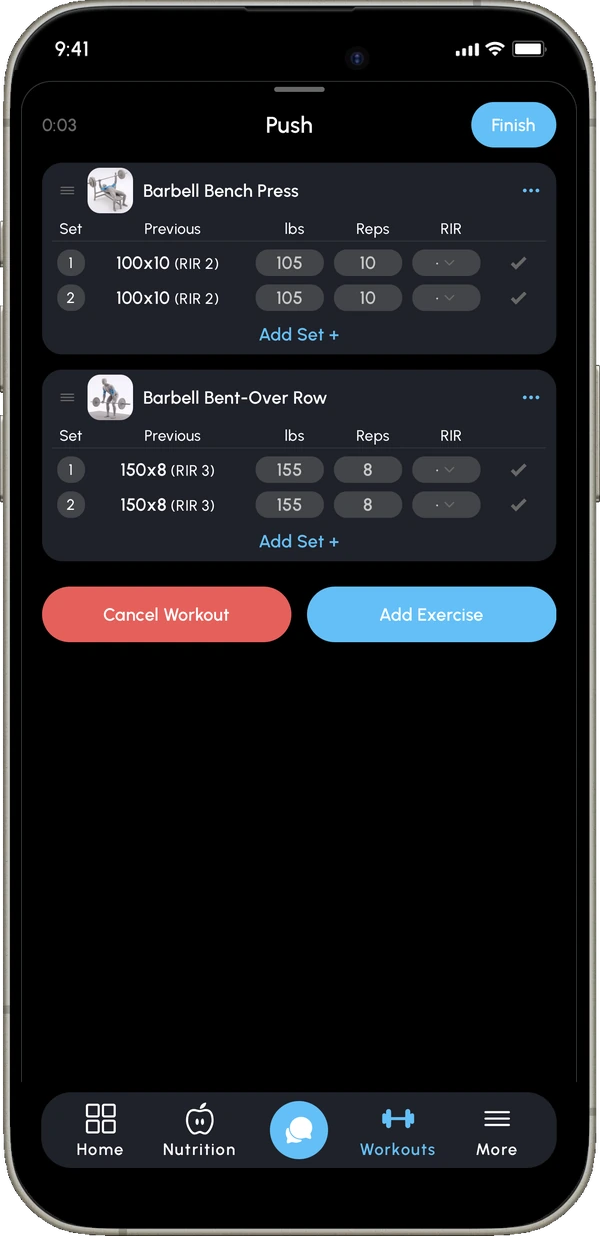
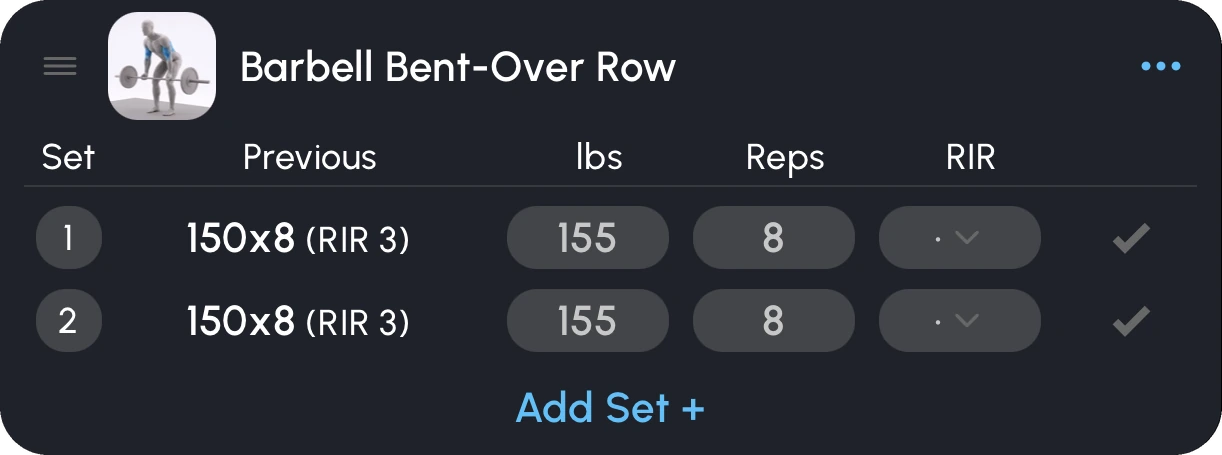
Progressive overload depends on knowing what you did last time. Without a log, it's easy to repeat the same weight for months, or to jump too far on a good day. If you write down the weight, reps and effort for every working set, you walk into each workout with a clear target: match last time, then beat it by a little.


When progress stalls
You'll probably hit a plateau at some point. Before you change your whole program, check these first:
- Sleep. A few short nights can show up fast in your strength.
- Protein and calories. It's much harder to add weight in a big calorie deficit. See What are macros? for protein targets.
- Fatigue. Taking a lighter week, called a deload, every 4 to 8 weeks lets fatigue clear so your strength can show.
- Exercise choice. If one lift has been stuck for a month, a close variation, like a different grip or a dumbbell version, can get you moving again.
Common questions
How quickly can I add weight?
Beginners can often add weight every workout or every week for the first few months. As you get more experienced, that slows to every few weeks, and more of your progress comes from reps and sets.
What if I can't add weight anymore?
You can add reps, add a set, or lower the weight more slowly. Any of these keeps the overload going until you're ready to add weight again.
Is progressive overload only for lifting?
No. It works the same way for running, cycling and swimming: a little more distance, speed or time than you're used to, built up over time.
Does progressive overload work at home?
Yes. With dumbbells or your body weight, you can add reps, add sets, slow your reps down or move to harder versions, like going from push-ups on a bench to push-ups on the floor, then with your feet raised.
How often do lifters deload?
Many take a lighter week every 4 to 8 weeks, or whenever their performance drops for more than a workout or two in a row.
Sources
- American College of Sports Medicine. Position stand: progression models in resistance training for healthy adults. Medicine and Science in Sports and Exercise (2009).
- Plotkin D. et al. Progressive overload without progressing load? The effects of load or repetition progression on muscular adaptations. PeerJ (2022).
- Schoenfeld B.J. et al. Dose-response relationship between weekly resistance training volume and increases in muscle mass: a systematic review and meta-analysis. Journal of Sports Sciences (2017).
- Refalo M.C. et al. Influence of resistance training proximity-to-failure on skeletal muscle hypertrophy: a systematic review with meta-analysis. Sports Medicine (2023).