Every packaged food in the U.S. has a Nutrition Facts label, and once you know where to look, it only takes a few seconds to read. The example below is for plain nonfat Greek yogurt. Use the − and + buttons to see how the numbers change with more or fewer servings.
How to Read a Nutrition Label
What every line on a Nutrition Facts label means, using a real example, plus the most common mistakes.
What each line on the label means
How many servings
Click any part of the label to see what it means.
Nutrition Facts
About 5 servings per container
Serving size3/4 cup (170g)
Amount per serving
Calories100
% Daily Value*
Total Fat 0.5g1%
Saturated Fat 0g0%
Trans Fat 0g
Cholesterol 10mg3%
Sodium 60mg3%
Total Carbohydrate 6g2%
Dietary Fiber 0g0%
Total Sugars 6g
Includes 0g Added Sugars0%
Protein 17g
Vitamin D 0mcg0%
Calcium 190mg15%
Iron 0.1mg0%
Potassium 240mg6%
* The % Daily Value (DV) tells you how much a nutrient in a serving of food contributes to a daily diet. 2,000 calories a day is used for general nutrition advice.
Serving size
Every number on the label is for one serving, not the whole package. This tub holds about 5 servings of 3/4 cup. If you eat a full cup, that's about 1⅓ servings, so every number goes up by about a third. Try the − and + buttons above the label to see it happen.
Calories
This is the energy in one serving. You lose, keep or gain weight based on your calories, so this is the first number to log. For how to set your own target, see How to count calories to lose weight.
% Daily Value
This shows how much of a day's worth one serving gives you, based on a 2,000-calorie diet. The FDA's rule of thumb is that 5% or less is low and 20% or more is high. Your own targets may be different, so it works best as a quick way to compare foods. Most labels leave it blank for protein.
Fat, carbs and protein
These are your macros, and they make up the calories. Protein and carbs have 4 calories per gram and fat has 9, so you can check the math yourself: 17 × 4 + 6 × 4 + 0.5 × 9 comes to about 97, close to the 100 on the label. Labels round every number, so it's rarely exact. For more, see What are macros?
Cholesterol and sodium
Labels list both in milligrams. The Daily Value for sodium is 2,300 mg, and most Americans eat more than that, with most of it from packaged and restaurant foods. This yogurt has 60 mg, which is low.
Fiber and sugars
Both are part of total carbs. Total Sugars counts every sugar in the food, and Added Sugars shows how much the maker put in. The 6 grams here come from the milk itself, so added sugars are 0. The Dietary Guidelines for Americans recommend keeping added sugars under 10% of your calories.
Vitamins and minerals
Every label lists vitamin D, calcium, iron and potassium, because many Americans don't get enough of them. One serving of this yogurt has 15% of your calcium for the day.
Common mistakes when reading labels
- Logging one serving when you ate more. A bag of chips or a bottle of juice often holds 2 or 3 servings. The servings per container line near the top of the label shows how many.
- Missing the second column. Some packages you could finish in one sitting or several, like a pint of ice cream, list the numbers for one serving and for the whole package side by side.
- Trusting every 0. Labels round small amounts down, so they list under 5 calories as 0, and under half a gram of fat, sugar or protein as 0 grams. A cooking spray can say 0 calories because its serving is a spray of about a second or less.
- Weighing food cooked when the label means dry. Most labels for rice, pasta, oats and meat give the dry or raw weight. 2 oz (56 g) of dry pasta turns into about 1 cup cooked.
- Skipping the ingredients list. It's in order by weight, starting with whatever the food has the most of. If sugar is one of the first few, the food has a lot of it.

Need an app to track your food?
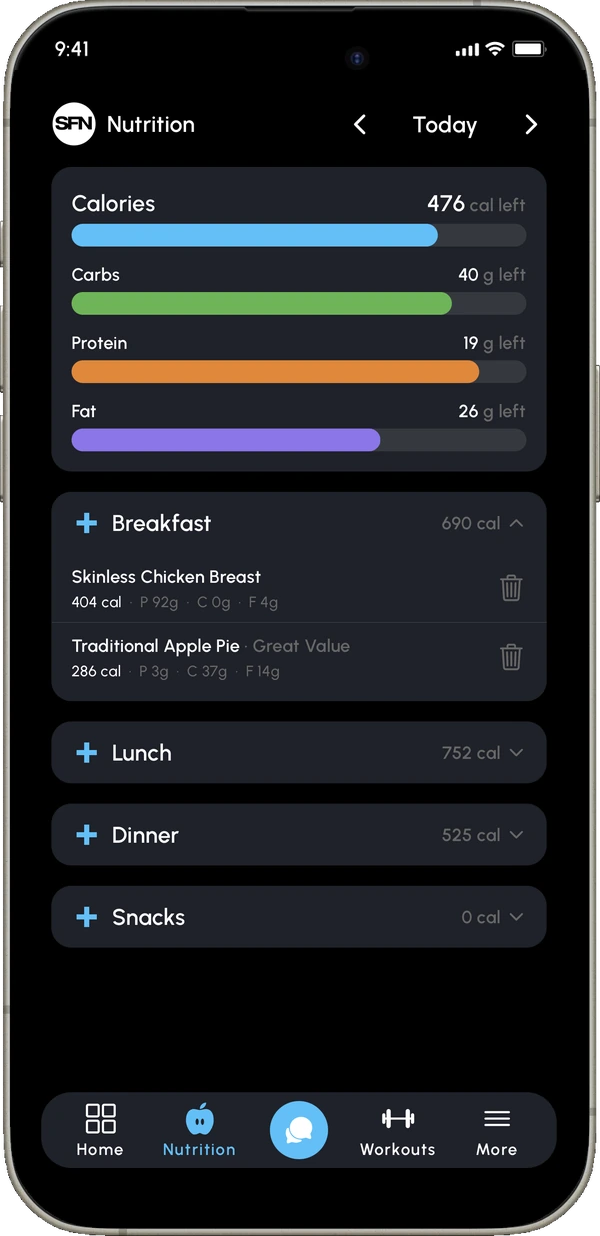
Somatics gives you two quick ways to track your food: search for it, or scan the barcode on the package. The barcode scanner is free.


Common questions
How accurate are nutrition labels?
They're accurate enough to track with. FDA rules allow some room: the real calories, sugars, fat and sodium can be up to 20% higher than the label says, and protein, fiber and vitamins that come naturally from the food can be up to 20% lower.
Do I count net carbs?
Net carbs, usually total carbs minus fiber, aren't on the official label, because the FDA doesn't define them. U.S. labels, and most tracking apps, use total carbs.
Why is the % Daily Value for protein often blank?
The Daily Value for protein is 50 grams, and labels only show a %DV for protein when the package makes a protein claim, like "high in protein." Most people who work out eat well over 50 grams a day. To see how much is right for you, try our free Protein Calculator.
What about foods without a label?
Fresh fruit, vegetables and fish usually don't come with one. For those, our Food Directory lists the numbers from USDA data.
Sources
General information, not medical advice. If you have a food allergy or a health condition, go with what your doctor or dietitian recommends.
Track macros and calories
with Somatics