To build muscle, anything from about 5 to 30 reps a set works, as long as each set ends close to failure. Heavy weights for low reps build a bit more strength, while light weights for high reps tend to feel worse and leave you more worn out. So most people do best with about 5 to 15 reps on most exercises.
Rep ranges at a glance
For most people, three ranges cover just about everything:
| Reps per set | Weight | Use it for | Good for |
|---|---|---|---|
| 5 to 8 | Heavy | Big compound lifts | Strength and muscle |
| 8 to 12 | Moderate | Most exercises | Muscle and strength |
| 12 to 15 | Lighter | Machines and small exercises | Muscle |
Sets of 15 to 30 reps build muscle too, as long as you push them close to failure. They feel a lot worse, though, so most people stay at 15 or under.
Heavy vs light: which builds more muscle?
When people push their sets to failure, heavy and light weights build a similar amount of muscle. A 2021 meta-analysis of 28 studies and 747 adults compared heavy loads (8 reps or fewer), moderate loads (9 to 15 reps) and light loads (more than 15 reps), all taken to failure. Muscle growth didn't differ between them.
A 2022 meta-analysis found the same thing when the total weight lifted was matched, and a 2026 position stand from the American College of Sports Medicine concluded that loads from about 30% of your max up to 100% build muscle about equally.
There is a floor, though. In a 2018 study, 30 untrained men lifted weights from 20% to 80% of their max for 12 weeks. At 20%, about a fifth of their max, their thigh muscles grew about 8.9%. At 40%, 60% and 80%, they grew about 20%. So a weight that feels really light for you probably won't build much muscle.
Light sets have to be hard
Light weights only build muscle if you push them. In a 2022 study, men trained with a light weight, about 30% of their max, either to failure (about 34 reps) or stopping at about 20 reps. The failure group grew about 7.8%, and the group that stopped early barely grew at all. With a heavy weight, about 80% of their max, stopping short of failure made no real difference.
You don't have to go all the way to failure with moderate weights either. In a 2024 study of 18 people who already lifted, stopping 1 or 2 reps short of failure built the same amount of quad muscle as going to failure, with less fatigue afterward. To judge how many reps you've got left in a set, use RIR (reps in reserve).
Heavy vs light for strength
If you want to lift more weight, heavier sets come out ahead. A 2023 meta-analysis of 178 studies found that loads above 80% of your max built the most strength. In the 2022 study above, the men who trained at about 80% of their max raised their one-rep max by about 34%, compared with about 18% for the light-weight group.
Part of strength is practice. If you want a bigger bench or squat, it helps to spend some time lifting heavy on those lifts. Lighter sets still make you stronger, just not as much.
Why most people stick with 5 to 15 reps
Since every range builds muscle, pick the one you'll push hard week after week. For most people, that's somewhere in the middle.
- Light sets hurt more. In a 2019 study, trained men rated sets of 25 to 30 reps as harder and more uncomfortable than sets of 8 to 12, and they called the light sets unpleasant.
- Light sets take longer to bounce back from. In a 2021 study, legs trained to failure with a light weight still hadn't recovered after 48 hours, while legs trained with a heavy weight had recovered by 24 hours.
- Very heavy sets take more time. You need more warm-up sets to work up to a heavy weight, and you'll want longer rest between sets. Our post on how long to rest between sets has rest times by exercise.
A 2021 review on getting results in less time landed on about 6 to 15 reps as a practical range, or 15 to 40 reps if you take the sets to failure.
How to pick reps for each exercise
These are example ranges, so adjust them to what feels right on each lift:
- Big compound lifts like squats, deadlifts, bench press and rows: 5 to 8 reps. You can load these heavy, and they're where most people track their strength.
- Most other exercises, like lunges, the leg press, dumbbell presses and lat pulldowns: 8 to 12 reps.
- Machines and small isolation exercises like curls, lateral raises, leg extensions and calf raises: 12 to 15 reps. With heavy weights, your form on these gets sloppy fast.
Pick a range, stay with the same weight until you reach the top of the range on all your sets, then add weight and start back at the bottom. Progressive overload walks through it step by step.
Should you mix rep ranges?
You can, and it may help your strength a little. A 2022 meta-analysis of 35 studies found that changing your rep ranges over time didn't build more muscle than keeping them the same, as long as the total work matched. It did lead to a little more strength, mostly in people who already lifted.
So if you like switching between a heavy day and a lighter day, go for it. If you'd rather keep the same ranges, that works just as well for muscle.
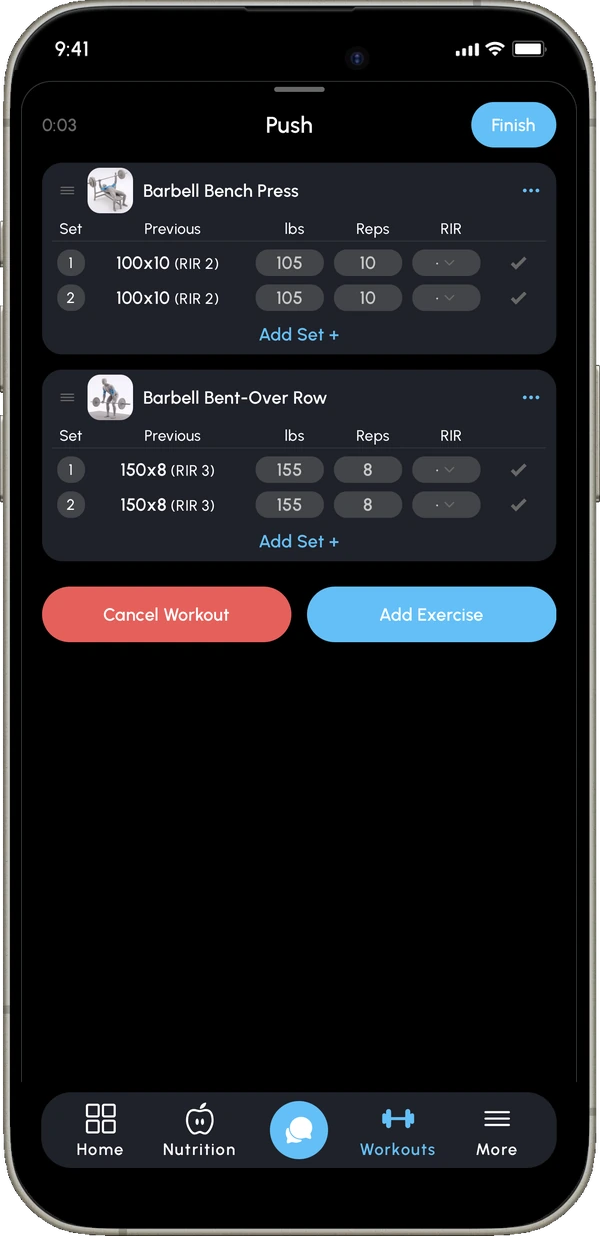
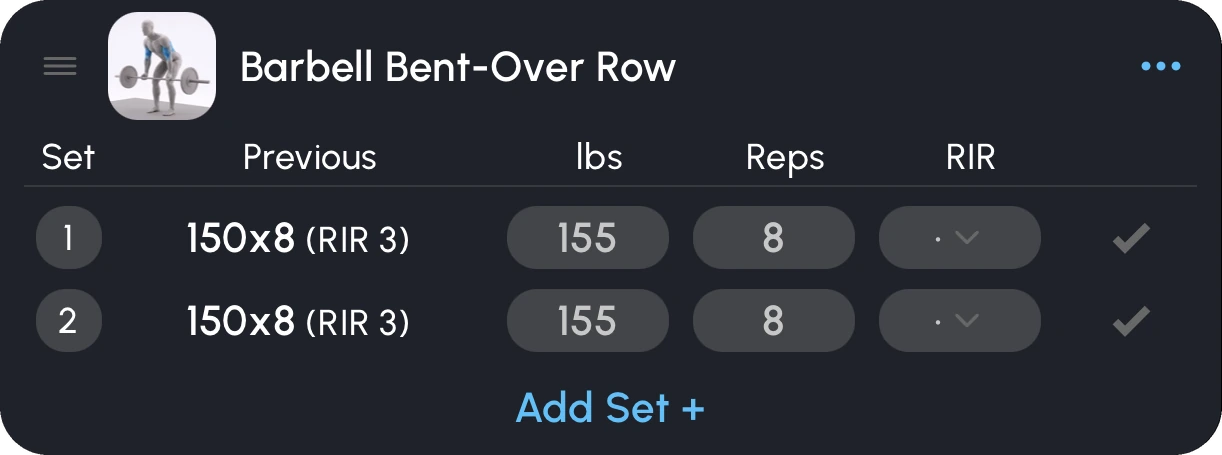
Whatever range you pick, log each set so you can see when you've hit the top and it's time to add weight.


Common questions
Is 3 sets of 10 good for building muscle?
Yes. Ten reps sits right in the middle of the range that builds muscle well. The number of hard sets you give each muscle per week matters more than the exact reps. See how many sets per week to build muscle.
Can you build muscle with 20 reps?
Yes, as long as the last few reps are a real struggle. In the 2022 study above, light sets only built muscle when people pushed close to failure.
Are low reps bad for building muscle?
No. Sets of 3 to 5 reps build muscle too. You'll need more of them to get the same amount of work in, and since they take more warm-up sets and longer rest, your workouts run longer.
How many reps should I do to tone up?
Toning is building some muscle and losing some fat, so the same ranges apply. Lift in the 5 to 15 rep range, keep adding weight over time, and use your diet to drop the fat.
Do high reps burn more fat?
Not that research has shown. Your calories drive fat loss, whichever range you lift in. Lifting while you diet helps you keep the muscle you have, and any of these ranges can do that.
Sources
- Lopez P. et al. Resistance Training Load Effects on Muscle Hypertrophy and Strength Gain: Systematic Review and Network Meta-analysis. Medicine and Science in Sports and Exercise (2021).
- Carvalho L. et al. Muscle hypertrophy and strength gains after resistance training with different volume-matched loads: a systematic review and meta-analysis. Applied Physiology, Nutrition, and Metabolism (2022).
- Currier B.S. et al. American College of Sports Medicine position stand: resistance training prescription for muscle function, hypertrophy, and physical performance in healthy adults. Medicine and Science in Sports and Exercise (2026). (Disclosure: one author formerly advised a fitness equipment company.)
- Lasevicius T. et al. Effects of different intensities of resistance training with equated volume load on muscle strength and hypertrophy. European Journal of Sport Science (2018).
- Lasevicius T. et al. Muscle Failure Promotes Greater Muscle Hypertrophy in Low-Load but Not in High-Load Resistance Training. Journal of Strength and Conditioning Research (2022).
- Refalo M.C. et al. Similar muscle hypertrophy following eight weeks of resistance training to momentary muscular failure or with repetitions-in-reserve in resistance-trained individuals. Journal of Sports Sciences (2024).
- Currier B.S. et al. Resistance training prescription for muscle strength and hypertrophy in healthy adults: a systematic review and Bayesian network meta-analysis. British Journal of Sports Medicine (2023). (Disclosure: one author has received research funding and fees from food and nutrition companies.)
- Ribeiro A.S. et al. Acute Effects of Different Training Loads on Affective Responses in Resistance-trained Men. International Journal of Sports Medicine (2019).
- Farrow J. et al. Lighter-Load Exercise Produces Greater Acute- and Prolonged-Fatigue in Exercised and Non-Exercised Limbs. Research Quarterly for Exercise and Sport (2021).
- Iversen V.M. et al. No Time to Lift? Designing Time-Efficient Training Programs for Strength and Hypertrophy: A Narrative Review. Sports Medicine (2021).
- Moesgaard L. et al. Effects of Periodization on Strength and Muscle Hypertrophy in Volume-Equated Resistance Training Programs: A Systematic Review and Meta-analysis. Sports Medicine (2022).