Most people build muscle well with about 10 to 20 hard sets per muscle group per week. If you're new to lifting, you can grow on less, around 6 to 10 sets. Spread those sets over at least two workouts, so each muscle gets trained about twice a week.
Weekly sets are one of the easiest ways to measure how much you're training. If you know how many hard sets each muscle gets in a week, you can tell whether you're doing too little, about right, or more than you can recover from.
What the research says
A 2017 review of training volume studies found that muscle growth went up as weekly sets went up. People doing 10 or more sets per muscle a week gained noticeably more muscle than people doing fewer than 5.
A 2022 review that looked at higher volumes found that about 12 to 20 sets per muscle a week worked best for people with some training experience. Going past 20 sets didn't add much extra growth for most people, and it made recovering between workouts harder.
| Experience | Hard sets per muscle a week |
|---|---|
| Beginner (first 6 to 12 months) | About 6 to 10 |
| Intermediate | About 10 to 15 |
| Advanced | About 12 to 20 |
These ranges are starting points. Some people grow well near the bottom of the range, and others do better near the top. If you track your sets and your progress, you'll see where you fall.
What counts as a set?
Only hard sets count. A hard set is one you take close to failure, usually within 0 to 3 reps in reserve. That means you could only have done three more good reps at most when you stopped. For more on that, see What does RIR mean in lifting?
Warm-up sets don't count, and neither do easy sets where you stop with five or more reps left. Ten sets that end far from failure won't build as much muscle as five sets that end close to it.
Counting compound lifts
Big lifts work more than one muscle at a time. A bench press trains your chest, but your triceps and the front of your shoulders do plenty of work too. Rows and pulldowns train your back, and your biceps help on every rep.
A simple way to count is to give the main muscle a full set and the helping muscles half a set. So 4 sets of bench press count as 4 sets for chest and about 2 sets each for triceps and shoulders. Your arms are where this counting makes the biggest difference, because they often get a lot of work from your bigger lifts already.
How many sets per workout?
Divide your weekly sets by how many times you train that muscle. If you're aiming for 12 sets of chest a week and you train chest twice, that's about 6 sets of chest in each workout.
Spreading sets out keeps each workout manageable and keeps your later sets from getting sloppy. If you find yourself doing 10 or more hard sets for one muscle in a single workout, it's usually better to move some of them to another day. For ways to set up your week, see Push pull legs vs upper lower vs full body.
An example week
On a 4-day upper lower split, about 12 weekly sets for chest and 12 for back can look like this:
| Day | Chest | Back |
|---|---|---|
| Monday (upper) | Bench press, 3 sets Incline dumbbell press, 3 sets | Barbell row, 3 sets Lat pulldown, 3 sets |
| Thursday (upper) | Incline press, 3 sets Cable fly, 3 sets | Pull-ups, 3 sets Seated cable row, 3 sets |
| Weekly total | 12 sets | 12 sets |
In this week, your biceps already get about 6 sets from the rows, pull-ups and pulldowns, and your triceps get about 6 from the presses. Adding 4 to 6 direct sets for each arm on top of that puts them right in the normal range.
To see a full week with sets for every muscle, try the Routine Finder. It picks a weekly routine example based on how many days you train.
How to find your number
- Start at the low end. Begin with about 10 sets per muscle a week, or 6 to 8 if you're new.
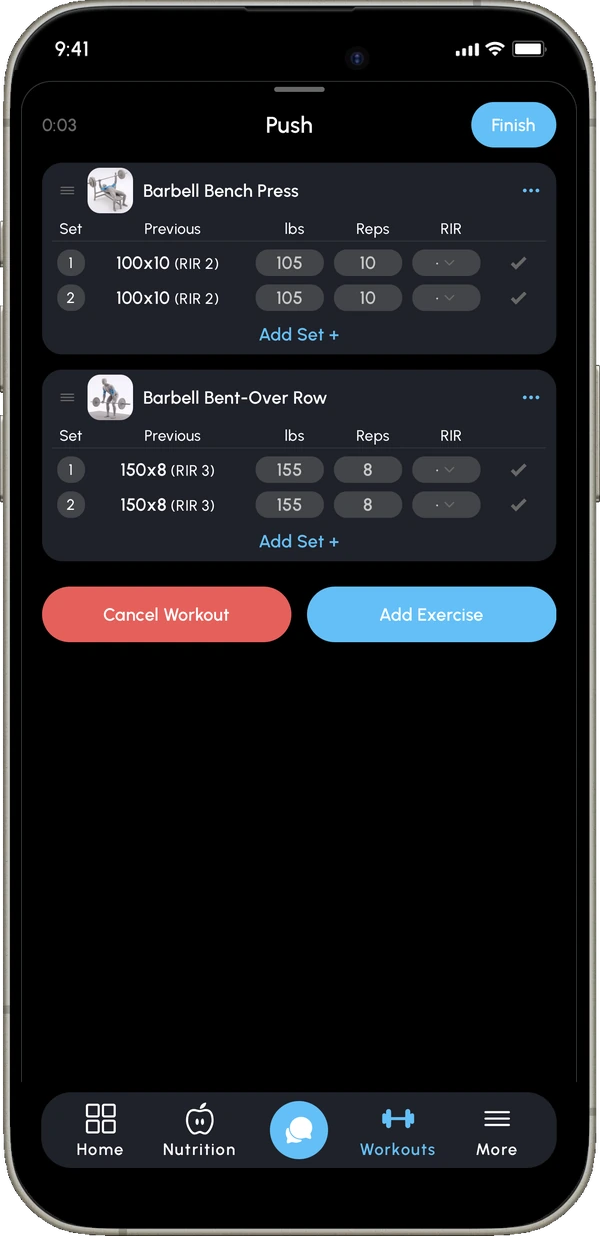
- Train hard and track it. Log your weight, reps and RIR so you can see whether you're getting stronger.
- Add sets slowly. If a muscle stops progressing for a few weeks and you're recovering well, add 2 sets a week for that muscle.
- Watch for signs of too much. If your lifts are going down, your joints ache or you're tired all the time, cut back a few sets or take a lighter week. See What is a deload week?
More sets only help if you can recover from them. Sleep, protein and calories all affect how many sets you can handle. If you're eating in a calorie deficit, you may do better toward the lower end of your range.


Common questions
How many sets per week for chest?
About 10 to 20 hard sets for most people who have been lifting for a while, and 6 to 10 if you're new. Bench press, incline press, dips, push-ups and flyes all count toward it.
How many sets per week for biceps?
Your biceps work hard on every row, pull-up and pulldown, so they often need fewer direct sets than you'd think. If your back training adds up to 10 or more sets, about 4 to 8 sets of curls a week is usually plenty.
How many sets per week for legs?
Count your quads, hamstrings and glutes as separate muscles. Squats, leg presses and lunges mostly train your quads and glutes, while Romanian deadlifts and leg curls train your hamstrings. Most people do well with about 10 to 20 hard sets a week for each, or 6 to 10 if they're new.
Is 3 sets per exercise enough?
It depends on how many exercises you do for that muscle. Three sets of one exercise trained twice a week adds up to 6 weekly sets, which is a good start for a beginner. Two exercises of 3 sets, twice a week, gets you to 12.
Can I build muscle with fewer sets?
Yes, especially if you're new or short on time. Even 4 or 5 hard sets per muscle a week builds muscle. You'll grow more slowly than with more sets, but it's far better than skipping the gym.
Do more sets always mean more muscle?
No. Growth tends to level off somewhere around 20 sets per muscle a week for most people. Past that, extra sets mostly add fatigue. If your lifts aren't going up, adding effort to the sets you already do often works better than adding more of them.
Sources
- Schoenfeld B.J. et al. Dose-response relationship between weekly resistance training volume and increases in muscle mass: a systematic review and meta-analysis. Journal of Sports Sciences (2017).
- Baz-Valle E. et al. A systematic review of the effects of different resistance training volumes on muscle hypertrophy. Journal of Human Kinetics (2022).
- Refalo M.C. et al. Influence of resistance training proximity-to-failure on skeletal muscle hypertrophy: a systematic review with meta-analysis. Sports Medicine (2023).
- Schoenfeld B.J. et al. How many times per week should a muscle be trained to maximize muscle hypertrophy? A systematic review and meta-analysis of studies examining the effects of resistance training frequency. Journal of Sports Sciences (2019).