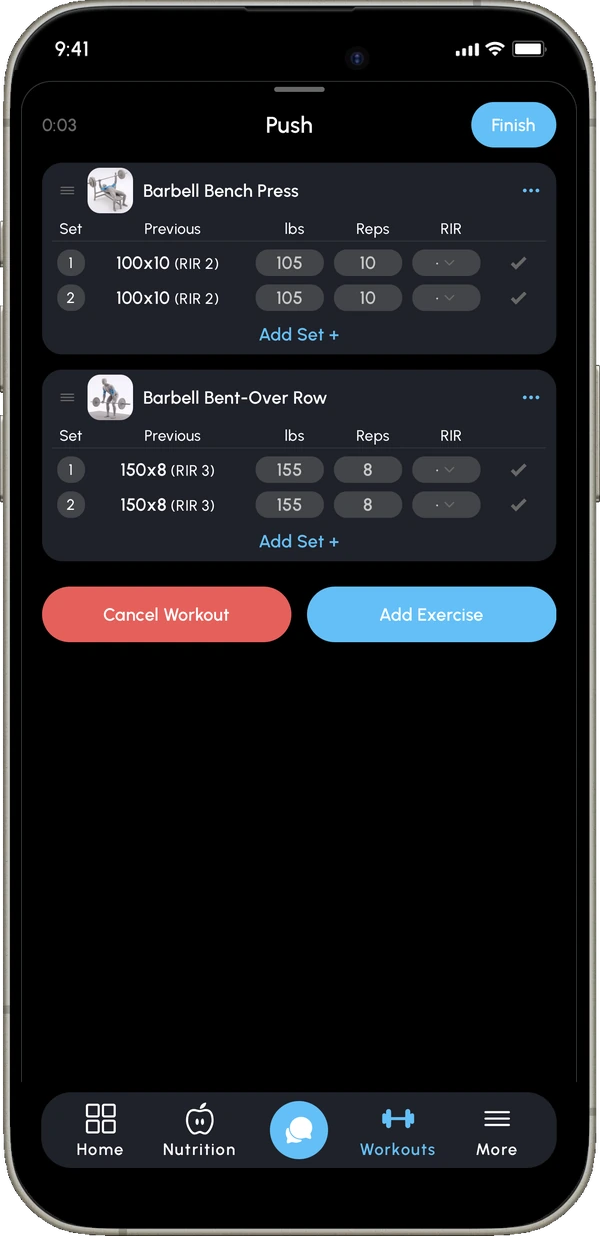
A deload week is a planned week of easier training. You still go to the gym and do your usual exercises, but you cut back on sets, weight or effort so the fatigue from weeks of hard training can clear. Most lifters take one every 4 to 8 weeks, or whenever their progress stalls.
It can feel strange to train less on purpose, but a deload is part of getting stronger. Hard training builds up fatigue faster than a couple of rest days can clear it. A lighter week lets your body catch up, so you come back ready to keep progressing.
Why lifters deload
Every hard workout leaves you a little tired, and most of that fatigue clears by your next session. Over weeks of training, though, some of it sticks around: your joints feel beat up, the same weights start to feel heavier and your motivation dips. That leftover fatigue can make you lift less than you're capable of.
A group of strength coaches and researchers who agreed on a definition in 2023 described deloading as a period of reduced training demand meant to manage fatigue and improve your readiness for the training that follows. A deload lets that fatigue clear, so your next block of training goes better.
How often to deload
A 2024 survey of 246 competitive strength and physique athletes found that all of them deloaded. On average, they took one about every 5 to 6 weeks, and it lasted about a week. Most planned their deloads ahead of time, and many also took one early when their performance stalled or their joints started to ache.
| Your training | How often to deload |
|---|---|
| First 6 months of lifting | Rarely, only if you feel run down |
| Training hard 3 to 4 days a week | About every 6 to 8 weeks |
| Training hard 5 to 6 days a week | About every 4 to 6 weeks |
If you're a beginner, you usually recover quickly and lift lighter weights, so you can often go months without a deload. The heavier and harder you train, the more often a lighter week helps.
Signs you're due for a deload
- Your lifts are going backward. Your weights or reps have dropped for two or more workouts in a row.
- The same weight feels harder. A set that used to end at 2 reps in reserve now ends at 0 or 1. For more on that, see What does RIR mean in lifting?
- Your joints ache. Elbows, knees or shoulders feel sore going into workouts, not just after them.
- You're dreading the gym. Your motivation has dropped and stayed down for a week or more.
- You're sleeping worse. Poor sleep can be a sign that you're carrying too much fatigue.
A pattern over a week or two is a better sign than one bad workout.
How to deload: three ways
You can make a week easier in a few different ways. In the 2024 survey, most athletes kept training on their usual days and cut back on sets and reps.
| Method | What you change | Example |
|---|---|---|
| Fewer sets | Cut your sets roughly in half and keep the weight | 4 sets becomes 2 |
| Lighter weight | Keep your sets and drop the weight by about 10 to 20% | 185 lb (84 kg) becomes 155 lb (70 kg) |
| Less effort | Keep the weight and stop each set much further from failure | 2 RIR becomes 4 or 5 RIR |
Cutting your sets is the simplest choice for most people. You keep practicing your lifts with familiar weights, but your body gets much less work to recover from. You can also combine methods, like fewer sets with a little less weight.
If you're following one of our workout routine examples, a deload week can be the same workouts with the sets cut roughly in half.
A sample deload week
This is what a deload can look like for someone who normally bench presses 185 lb (84 kg) for 4 sets of 8:
| Normal week | Deload week | |
|---|---|---|
| Bench press | 4 × 8 at 185 lb (84 kg), 1 to 2 RIR | 2 × 8 at 185 lb (84 kg), 3 to 4 RIR |
| Incline dumbbell press | 3 × 10, 1 to 2 RIR | 2 × 10, 3 to 4 RIR |
| Triceps pushdown | 3 × 12, 0 to 1 RIR | 1 to 2 × 12, 3 to 4 RIR |
These workouts are easy by design, and you'll leave the gym feeling like you could have done a lot more.
Will a deload make me lose progress?
No. A week of lighter training isn't nearly long enough to lose muscle. In a 2024 study, people who took a full week off in the middle of a 9-week program built about the same amount of muscle as people who trained straight through. The group that kept training came out a little ahead on some strength tests, which is one reason most lifters choose a lighter week over a full week off.
After the deload
Go back to the weights and sets you were using before the deload. You'll often find your lifts feel better than they did in the weeks before, and you may hit new personal bests within a week or two. From there, keep adding weight or reps as usual. For how to do that, see Progressive overload, explained.
If your progress stalls again a few weeks later and a deload didn't help, look at the rest of your recovery: sleep, protein and calories. You may also be doing more sets than you can recover from. See How many sets per week to build muscle?


Common questions
How long is a deload week?
Usually about 5 to 7 days. Some lifters use a shorter deload of 3 or 4 days if they only feel a little run down.
Can I take a week off instead?
Yes. A full week off works too, and it won't cost you muscle. Many lifters prefer a lighter week because it keeps the habit going and keeps the lifts feeling familiar.
Do beginners need a deload?
Not often. In your first several months, you're lifting lighter weights and recovering quickly. Take a lighter week if you feel run down, but there's no reason to schedule one.
Is it normal to feel weaker during a deload?
Yes. The lighter weights and fewer sets can leave you feeling a little flat, and some people feel restless with the extra energy. That feeling passes once you're back to normal training, and most people come back feeling stronger than before.
Do runners deload too?
Yes. Runners usually call it a recovery or "down" week, and it works the same way: they cut their weekly mileage by about a quarter to a half for a week, then build back up.
Can I do cardio during a deload?
Easy cardio like walking or a light bike ride is fine and can help you feel better. Keep anything hard to a minimum, since the goal of the week is to let fatigue clear.
Sources
- Bell L. et al. Integrating deloading into strength and physique sports training programmes: an international Delphi consensus approach. Sports Medicine - Open (2023).
- Rogerson D. et al. Deloading practices in strength and physique sports: a cross-sectional survey. Sports Medicine - Open (2024).
- Coleman M. et al. Gaining more from doing less? The effects of a one-week deload period during supervised resistance training on muscular adaptations. PeerJ (2024).