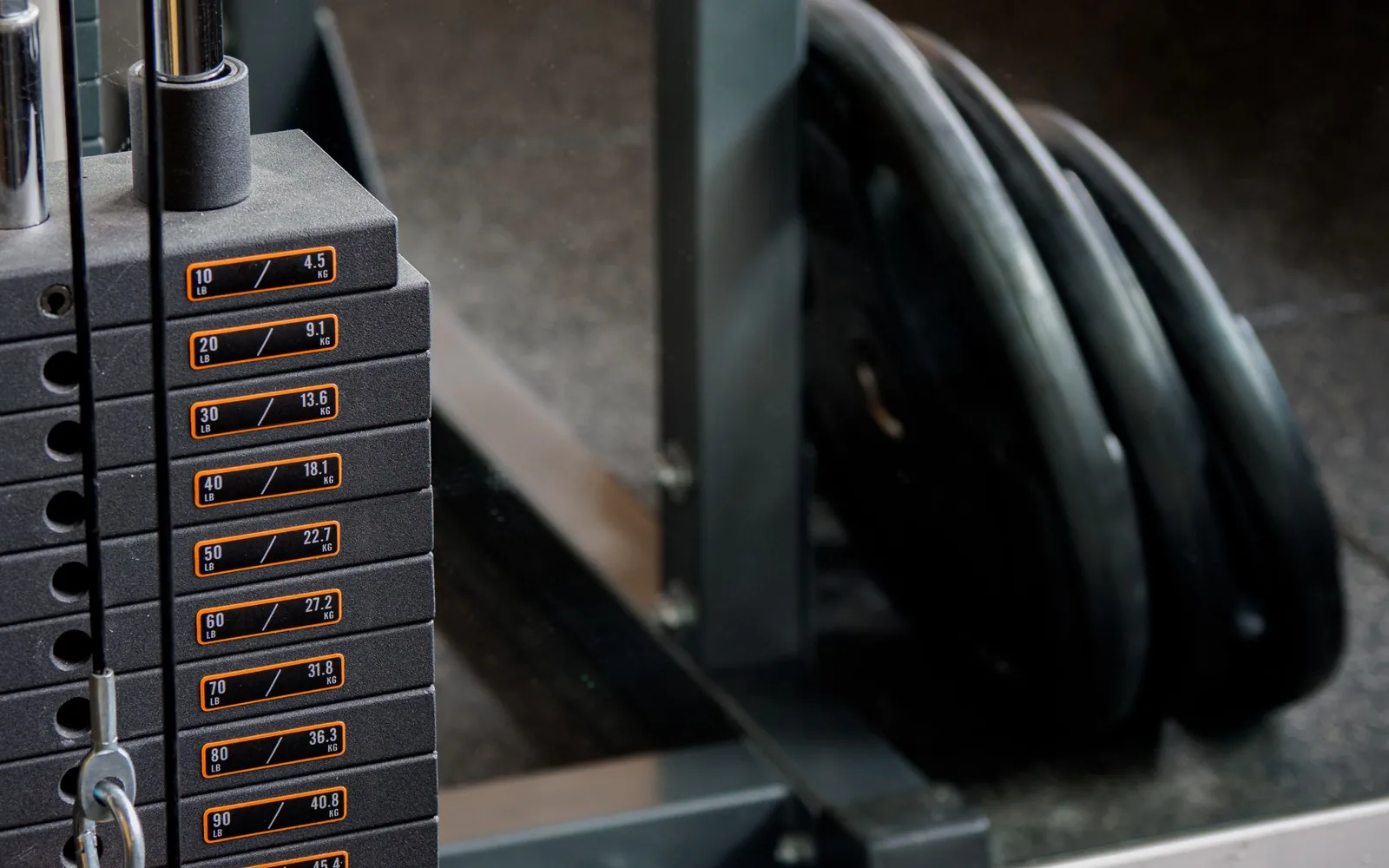
Machines and free weights build about the same amount of muscle. A 2023 review of 13 studies found similar muscle growth with both. The difference shows up in strength tests: people get stronger at whichever one they train with. The better choice comes down to your goals, your gym and what you enjoy using.
Most good programs use both: free weights for a few compound lifts, machines for the rest, and a swap whenever a machine is taken or a lift doesn't feel right.
What counts as a free weight or a machine?
- Free weights are barbells, dumbbells and kettlebells. You control the whole path of the weight, so your body steadies it as well as lifting it.
- Machines guide the weight along a fixed path. That includes pin-loaded machines with a weight stack, plate-loaded machines and the Smith machine, a barbell that slides on rails.
- Cables sit in between. The pulley sets the direction of the pull, but you control the path of the handle, so they feel a bit like free weights and a bit like machines.
What the research says
A 2023 systematic review and meta-analysis pooled 13 studies with 1,016 adults who trained with either free weights or machines for at least six weeks. Muscle growth came out about the same with both. Strength was more specific: the free-weight groups improved more on free-weight strength tests, like a barbell squat, and the machine groups tended to improve more on machine tests, like a leg press.
That fits what lifters see in the gym. Your muscles grow in response to how much work they do and how close to failure you take each set, whether the resistance comes from a barbell or a weight stack. Getting better at a specific lift, though, is partly a skill, and you get better at the lifts you practice.
Free weights: pros and cons
| Pros | Cons |
|---|---|
| Train you to steady the weight, which carries over to sports and everyday lifting | Take longer to learn, especially squats, deadlifts and presses |
| A rack, a barbell and some dumbbells cover almost every exercise | Harder to take close to failure safely without a spotter |
| Easy to use at home | Big barbell lifts tire you out more, which can cut into the rest of your workout |
| Best if you want to get stronger at the barbell lifts themselves | Small jumps in weight can be hard with fixed dumbbells |
Machines: pros and cons
| Pros | Cons |
|---|---|
| Easy to learn, with the path of the weight set for you | Every gym has different machines, and they don't all fit every body |
| Safe to push close to failure with no spotter | Less practice steadying a weight on your own |
| Easy to aim at one muscle, like hamstrings on a leg curl | Popular machines can have a wait at busy times |
| Quick to change the weight with a pin | Hard to set up at home |
Which one suits you?
If you're new to lifting, machines are an easy place to start. You can learn how a hard set feels, and how to judge your reps in reserve, while you get comfortable in the gym. Adding a free-weight lift or two over the first few months is a good way to build the skill.
If muscle is your main goal, use whatever lets you train each muscle hard and keep adding reps or weight. For many people, that's a mix. Machines come in handy for the last few sets of a workout, when you're tired and form on a barbell lift starts to slip.
If you want to get stronger at the big lifts, train those lifts, since you build squat, bench press and deadlift strength by practicing them.
If you train at home, free weights are the practical choice. See Dumbbell workouts at home for how to build muscle with a pair of dumbbells.
If you train alone, machines let you push sets closer to failure without the risk of getting stuck under a bar. Research on how close to failure to train found that muscle growth goes up as sets get closer to failure, so the extra safety lets you get more out of each set.
Machine swaps for the main lifts
Every exercise in our workout routine examples lists a swap, so you can trade a free weight for a machine or the other way around. Common ones include:
| Free-weight lift | Machine swap | Main muscles |
|---|---|---|
| Barbell squat | Leg press or hack squat | Quads, glutes |
| Bench press | Chest press machine | Chest, front shoulders, triceps |
| Pull-ups | Lat pulldown or assisted pull-up machine | Lats, upper back, biceps |
| Barbell row | Seated cable row or chest-supported row machine | Upper back, lats, biceps |
| Overhead press | Shoulder press machine | Shoulders, triceps |
| Romanian deadlift | Leg curl (hamstrings only) | Hamstrings |
If you'd like to see a full week on machines, our machines-only routine example has three full body workouts a week, and the machine workout example shows a single session with six machines covering every major muscle.
How to get the most out of machines
- Set the seat first. Most machines have a sticker showing where the joint lines up, like your knee with the pivot on a leg extension. A bad seat height makes the exercise feel wrong.
- Write down your settings. Seat height and pad position change how heavy a weight feels, so using the same settings each time keeps your numbers comparable.
- Use the full range. Let the weight stack nearly touch at the bottom of each rep without resting on it.
- Keep progressing. Machines work with progressive overload the same as free weights. Add a rep or the next pin when you can.


Common questions
Can you build muscle with only machines?
Yes. The research above found similar muscle growth with machines and free weights. As long as you train each muscle hard enough and keep progressing, the equipment matters a lot less than the effort.
Is the Smith machine a free weight?
No. The bar runs on fixed rails, so it's a machine. It's a good option for squats, presses and lunges when you want a barbell feel with a guided path.
Do machines skip your stabilizer muscles?
Machines work them less, since the machine steadies the weight. Your stabilizers still get work from your free-weight lifts, from cables and from everyday life. For muscle growth in the main muscles, it doesn't seem to matter much.
Are machines safer than free weights?
They're more forgiving when you're tired or close to failure, because you can stop a rep without dropping the weight. Free weights are safe too with good form, sensible weights and, for heavy barbell lifts, safety bars or a spotter.
What's the difference between a compound and an isolation exercise?
A compound exercise works several joints and muscles at once, like a squat or a row. An isolation exercise works one joint, like a curl or a leg extension. Both terms, and free weights, have entries in our Fitness Dictionary.
Sources
- Haugen M.E. et al. Effect of free-weight vs. machine-based strength training on maximal strength, hypertrophy and jump performance: a systematic review and meta-analysis. BMC Sports Science, Medicine and Rehabilitation (2023).
- Refalo M.C. et al. Influence of resistance training proximity-to-failure on skeletal muscle hypertrophy: a systematic review with meta-analysis. Sports Medicine (2023).
- American College of Sports Medicine. Position stand: progression models in resistance training for healthy adults. Medicine and Science in Sports and Exercise (2009).