You can build muscle at home with nothing but a pair of dumbbells. Research shows lighter weights build about as much muscle as heavy ones, as long as you take your sets close to failure. Three full body workouts a week, with a squat, a hinge, a push, a pull and a press, cover every major muscle.
At home, you can't walk over to the next dumbbell on the rack. Keeping your workouts challenging as you get stronger takes a few tricks, like adding reps and switching to single-leg exercises.
Can you build muscle with only dumbbells?
Yes. A 2017 meta-analysis compared training with light weights (60% of your one-rep max or less) against heavy weights. When people took their sets to failure, muscle growth was about the same. Heavy weights did build more maximal strength, since lifting heavy is partly a skill you practice.
For building muscle, the effort of each set counts most. Your muscles respond to tension and fatigue, and a set of 20 that ends one rep short of failure works them about as hard as a set of 8 that does. So if your dumbbells feel light for some exercises, you can make up for it with more reps, as long as the last few are a real effort.
Sets of 30 or more take a long time, and they can turn into a test of how much burning you can stand. You'll usually get the most out of sets of about 8 to 20.
What equipment to get
- Adjustable dumbbells save a lot of space and cover a range of weights in one pair. A set that goes up to 50 lb (about 23 kg) per hand covers most people for a long time. Stronger lifters may want more for squats and Romanian deadlifts.
- A bench is useful but optional. Without one, the floor works for presses, and a sturdy chair or couch works for split squats.
- A pull-up bar that fits in a doorway is a cheap way to add pull-ups, the one big back exercise that's hard to copy with dumbbells.
The best dumbbell exercises for each muscle
| Muscle | Main exercise | Other options |
|---|---|---|
| Quads, glutes | Goblet squat | Split squat, reverse lunge, step-up |
| Hamstrings, glutes | Romanian deadlift | Single-leg Romanian deadlift, hip thrust |
| Chest | Floor press or bench press | Push-ups, dumbbell fly |
| Back | One-arm dumbbell row | Chest-supported row, pull-ups |
| Shoulders | Standing or seated press | Lateral raise, rear delt fly |
| Biceps | Dumbbell curl | Hammer curl |
| Triceps | Overhead extension | Close-grip push-ups, kickbacks |
| Calves | Single-leg calf raise | Calf raise on a step |
Single-leg exercises like split squats and single-leg Romanian deadlifts help a lot at home. Working one leg at a time roughly doubles the load on that leg, so the same dumbbells keep your legs challenged for much longer.
An example home workout
Our home dumbbell workout example works your whole body with only dumbbells and no bench:
| Exercise | Sets × reps | Rest | RIR |
|---|---|---|---|
| Goblet squat | 3 × 10 to 12 | 1.5 min | 1 to 3 |
| Dumbbell floor press | 3 × 8 to 12 | 1.5 min | 1 to 2 |
| Dumbbell row | 3 × 10 to 12 per arm | 1.5 min | 1 to 2 |
| Dumbbell Romanian deadlift | 3 × 10 to 12 | 1.5 min | 1 to 3 |
| Standing dumbbell press | 2 × 10 to 12 | 1.5 min | 1 to 2 |
| Reverse lunges | 2 × 10 per leg | 1.5 min | 1 to 2 |
RIR stands for reps in reserve, the number of reps you could still do when you stop a set. If it's new to you, see What does RIR mean in lifting? Our home dumbbell routine example repeats this workout three days a week, on Monday, Wednesday and Friday, with a rest day between each one. A few minutes of our full body warm-up before you start gets you ready.
How to keep progressing without heavier weights
Progressive overload means making your workouts a little harder over time. In a gym, the easy way is more weight. At home, you have other options, and a 2022 study found that adding reps built about as much muscle as adding weight.
- Add reps. When you can do the top of your rep range at your target RIR, keep going up, to 15 or 20 reps, before you move up in weight.
- Add a set. Going from 2 to 3 or 3 to 4 sets for a muscle adds work without more weight.
- Slow down. Taking three seconds to lower the weight makes each rep harder.
- Pause. A one- or two-second pause at the bottom of a squat or press takes away the bounce.
- Switch to one side. Going from goblet squats to split squats, or two-arm to one-arm movements, puts more load on each side.
- Use a harder version. Push-ups with your feet raised, Bulgarian split squats with your back foot on a couch, or a deficit reverse lunge from a step all make the same weight feel heavier.
How many days a week?
Three full body workouts a week is a common starting point and trains each muscle three times. If you only have two days, two full body workouts still cover the U.S. Physical Activity Guidelines' minimum of strength training on 2 or more days a week. If you'd like to see which routine example fits your week, try our Routine Finder, and pick "Dumbbells" for equipment. For more on picking a schedule, see How many days a week to work out?
Tips for training at home
- Pick a set time. Without a commute to the gym, it's easy to push a workout back all day. A time on your calendar helps.
- Clear a space. About 6 by 6 feet (2 by 2 meters) is enough for every exercise above.
- Wear shoes with a flat sole. Socks on a hard floor slide, especially on lunges.
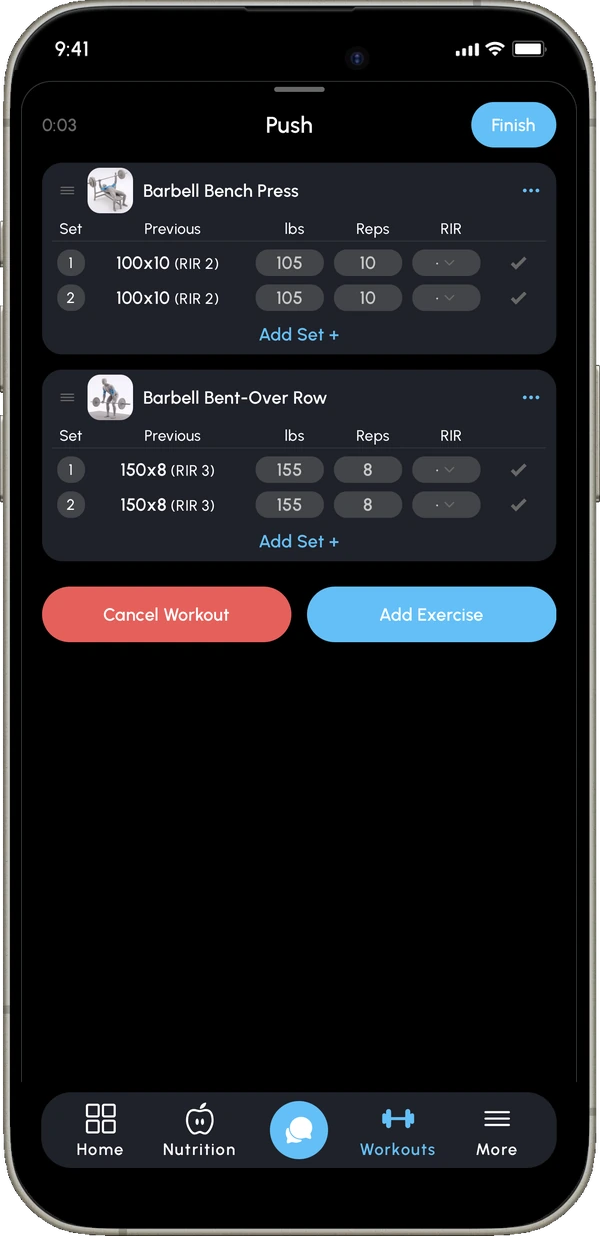
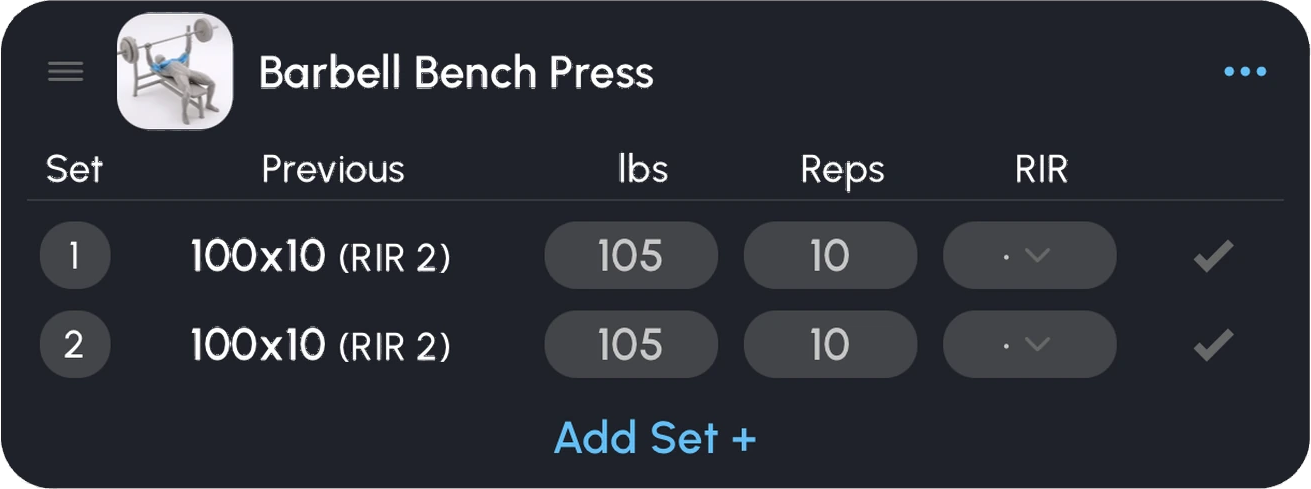
- Track your numbers. Writing down the weight, reps and RIR for each set is how you know you're progressing, and it's even more useful at home, where the weights don't change much.


Common questions
What weight dumbbells do I start with?
Heavy enough that the last couple of reps in each set feel hard. For many beginners, that's around 10 to 25 lb (4.5 to 11 kg) per hand for upper body exercises, and more for squats and Romanian deadlifts. Adjustable dumbbells let you use a different weight for each exercise.
Can I build muscle with light dumbbells?
Yes, as long as your sets end close to failure. With light dumbbells, use the progression ideas above, like single-leg exercises and slower reps, so you're not doing 40 reps a set.
Is a bench worth getting?
It helps, but you can do without one. The floor press works your chest well, and a chair or couch works for split squats and step-ups. A bench mostly adds more press and row variations.
Is a home workout as good as the gym?
For building muscle and staying healthy, a well-planned home workout gets you most of the way there. The gym makes it easier to train your legs heavy and to add small amounts of weight, and you can also mix the two.
Sources
- Schoenfeld B.J. et al. Strength and hypertrophy adaptations between low- vs. high-load resistance training: a systematic review and meta-analysis. Journal of Strength and Conditioning Research (2017).
- Plotkin D. et al. Progressive overload without progressing load? The effects of load or repetition progression on muscular adaptations. PeerJ (2022).
- Refalo M.C. et al. Influence of resistance training proximity-to-failure on skeletal muscle hypertrophy: a systematic review with meta-analysis. Sports Medicine (2023).
- U.S. Department of Health and Human Services. Physical Activity Guidelines for Americans, 2nd edition (2018).