Macros, short for macronutrients, are protein, carbs and fat. Almost all of the calories in your food come from them. A gram of protein or carbs has 4 calories, and a gram of fat has 9.
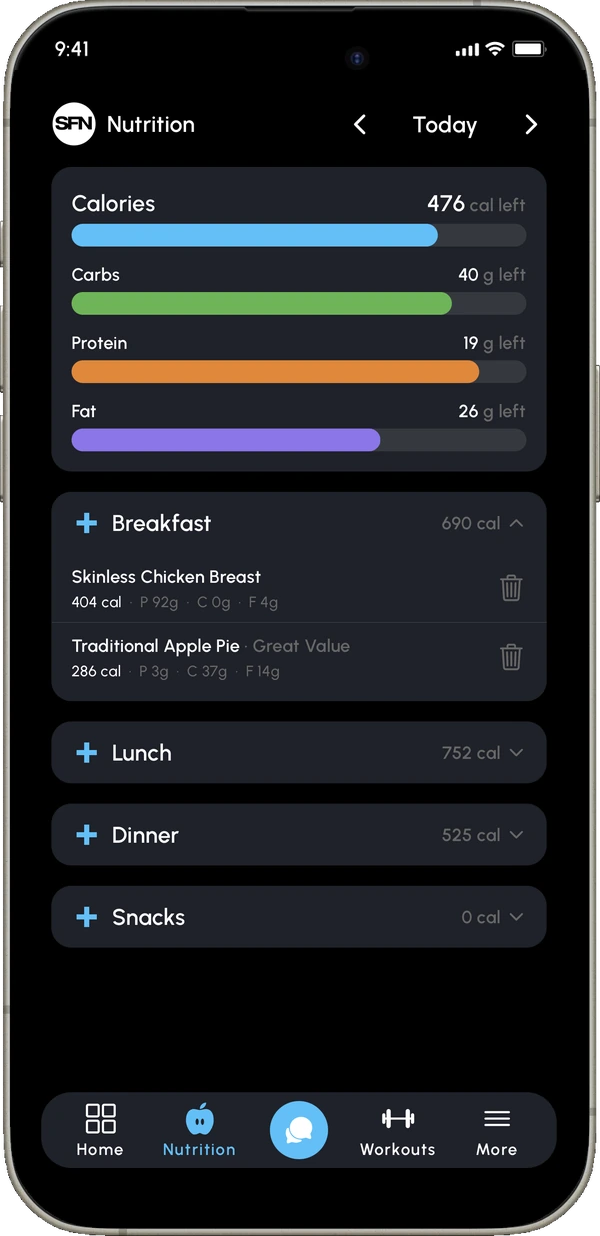
If you "count macros," you track how many grams of each you eat as well as your total calories. Two days can both add up to 2,000 calories and look nothing alike once you split them into protein, carbs and fat. You feel that difference in energy, hunger and how your workouts go.
The three macros at a glance
| Macro | Calories per gram | Main job | Common sources |
|---|---|---|---|
| Protein | 4 | Builds and repairs tissue, including muscle | Chicken, fish, eggs, Greek yogurt, tofu, beans |
| Carbohydrates | 4 | Your body's main fuel, especially for hard training | Rice, oats, potatoes, fruit, bread, pasta |
| Fat | 9 | Hormones, healthy cells and absorbing vitamins A, D, E and K | Olive oil, nuts, avocado, salmon, cheese |
Because those numbers are fixed, you can work out the calories in any meal from its macros. A meal with 30 g of protein, 50 g of carbs and 15 g of fat comes to about 120 + 200 + 135 = 455 calories.
Protein
Your body breaks protein down into amino acids and uses them to repair muscle after training, make hormones and enzymes, and keep your skin, hair and organs healthy. Protein also keeps you full longer than carbs or fat, which makes it easier to stick to a calorie deficit.
The official minimum for adults, called the RDA, is about 0.36 grams per pound of body weight a day (0.8 grams per kilogram). That's enough to avoid a deficiency, but if you train, you'll do better with more. If you lift or train most weeks, the International Society of Sports Nutrition recommends about 0.64 to 0.91 grams per pound a day (1.4 to 2.0 grams per kilogram).
If you weigh 176 lb (80 kg), that's about 112 to 160 grams of protein a day, or 30 to 40 grams at each of four meals.
Carbohydrates
Carbs are your body's main source of fuel. You digest them into glucose, which powers your brain and muscles, and your body stores the extra as glycogen in your muscles and liver. That stored glycogen keeps you going in long or hard workouts.
There are three main kinds of carbs:
- Sugars, in fruit, milk and anything sweetened
- Starches, in rice, potatoes, oats, bread and pasta
- Fiber, the part your body can't digest, in vegetables, beans, whole grains and fruit
Fiber is worth tracking on its own. The Dietary Guidelines for Americans recommend about 14 grams for every 1,000 calories you eat, which works out to 22 to 34 grams a day for most adults. Most people in the U.S. eat a lot less than that.
Fat
Fat has the most calories per gram, so a little oil, a handful of nuts or a slice of cheese adds up fast. You still need it. Your body uses fat to make hormones and build cells, and you can't absorb vitamins A, D, E and K without it. Your body also can't make omega-3 and omega-6 fats on its own, so you get them from food.
In a healthy diet, most of the fat comes from olive oil, nuts, seeds, avocado and fish. The Dietary Guidelines recommend keeping saturated fat, the kind in butter, fatty meat and full-fat dairy, under 10% of your daily calories.
What about alcohol?
Alcohol has 7 calories per gram, and those calories count toward your daily total. Nutrition guidelines don't count it as a macro, though, because your body doesn't need it.
How much of each macro?
The National Academies of Sciences, Engineering, and Medicine publish healthy ranges for adults, called the Acceptable Macronutrient Distribution Ranges:
| Macro | Share of daily calories | At 2,000 calories a day |
|---|---|---|
| Protein | 10 to 35% | 50 to 175 g |
| Carbohydrates | 45 to 65% | 225 to 325 g |
| Fat | 20 to 35% | 44 to 78 g |
The ranges are wide on purpose, because lots of different diets are healthy. Your spot in those ranges depends on your goals and how you train. If you're trying to build muscle, you'll probably sit near the top of the protein range. Endurance athletes often eat more carbs.
To work out your own numbers step by step, see How to calculate your macros. If you'd rather skip the math, our free Macro, TDEE & BMR Calculator will work them out for you in seconds.
Macros vs calories: which matters more?
If you eat more calories than you burn, you gain weight, and if you eat fewer, you lose it. Macros affect what that weight is made of, and how you feel along the way.
When you're eating in a calorie deficit, enough protein helps you keep your muscle while you lose fat. Enough carbs keep your workouts strong, and enough fat keeps your hormones and vitamin absorption on track. You can hit your calorie target with very little protein and still lose muscle along with the fat.
How to start tracking macros
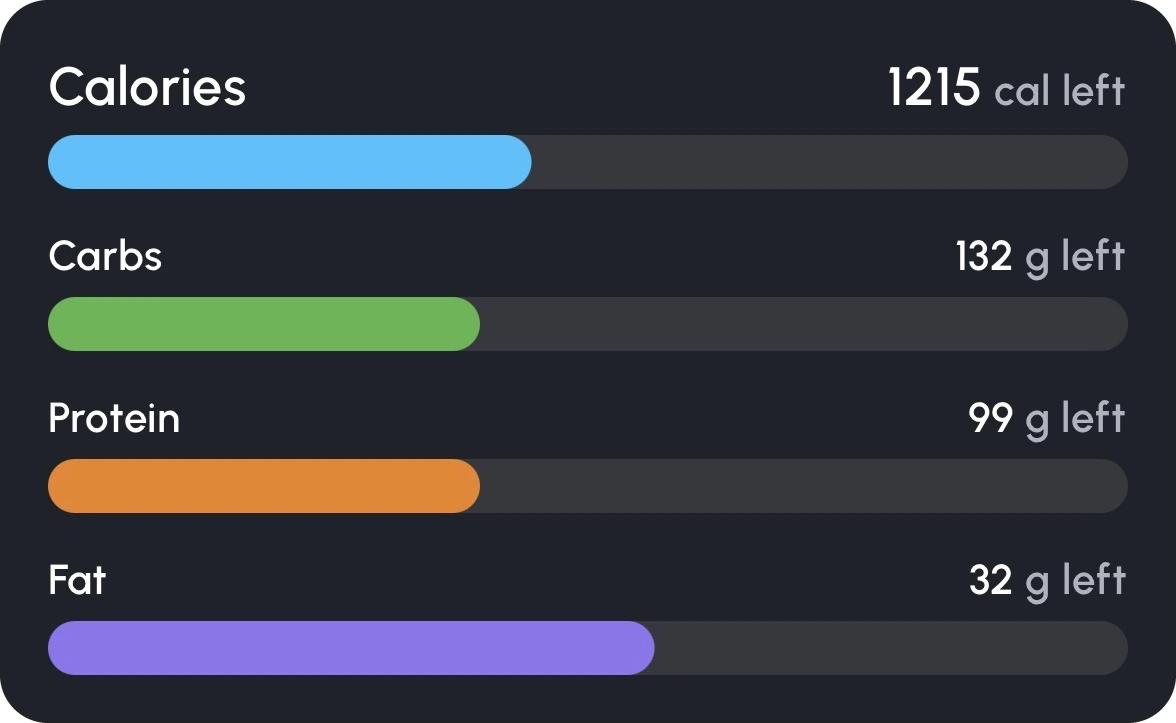
- Set your targets. Start with your daily calories, set protein first, then split what's left between carbs and fat.
- Log everything for a week. Include drinks, cooking oil and sauces. Most people undercount on small extras like these.
- Make logging fast. Scanning barcodes and saving meals you eat often cuts each entry down to a few seconds.
- Look at weekly averages. One day over or under matters a lot less than how the whole week averages out.
- Make small changes. If your weight or training isn't moving the way you want after two or three weeks, change one number at a time.


Common questions
Do macros matter if I hit my calorie target?
For weight loss on its own, calories matter most. For keeping muscle, staying full and having energy to train, macros make a big difference, and protein most of all.
Is it a problem if I miss my macros some days?
No. Think of your targets as a weekly average. Going a little over on carbs one day and a little under the next evens out.
What's the best macro split for weight loss?
There isn't one best split. A large 12-month study compared healthy low-carb and low-fat diets and found people lost about the same amount of weight on both, so a split you can keep up with matters more than the exact numbers. A good place to start is protein at 0.64 to 0.91 g per pound of body weight (1.4 to 2.0 g per kilogram), fat at 20 to 35% of calories, and carbs for the rest.
Is a food scale worth it?
For the first few weeks, yes. A kitchen scale makes your logs much more accurate, especially for oil, nuts and rice, which are easy to misjudge by eye. After that, you can probably estimate everyday meals closely enough.
Sources
- National Academies of Sciences, Engineering, and Medicine. Dietary Reference Intakes for Energy, Carbohydrate, Fiber, Fat, Fatty Acids, Cholesterol, Protein, and Amino Acids (2005).
- Jäger R. et al. International Society of Sports Nutrition Position Stand: protein and exercise. Journal of the International Society of Sports Nutrition (2017).
- U.S. Department of Agriculture and U.S. Department of Health and Human Services. Dietary Guidelines for Americans, 2020 to 2025.
- Gardner C.D. et al. Effect of low-fat vs low-carbohydrate diet on 12-month weight loss in overweight adults (DIETFITS). JAMA (2018).