Fiber keeps you full, helps your digestion and is good for your heart. The Dietary Guidelines for Americans recommend about 14 grams for every 1,000 calories you eat, which works out to 22 to 34 grams a day for most adults, and most people in the U.S. eat a lot less than that.
Food Directory



Track macros and calories
High-Fiber Foods
Everyday high-fiber foods, with the fiber, calories and macros for a normal serving of each.
Sort by
| Food | Calories | Protein | Carbs | Fat | Fiber |
|---|---|---|---|---|---|
| Split peas, cooked1 cup (196 g) | 231 | 16.3 g | 41.4 g | 0.8 g | 16.3 g |
| Lentils, cooked1 cup (198 g) | 230 | 17.9 g | 39.9 g | 0.8 g | 15.6 g |
| Navy beans, cooked1 cup (182 g) | 255 | 15 g | 47.4 g | 1.1 g | 19.1 g |
| Black beans, cooked1 cup (172 g) | 227 | 15.2 g | 40.8 g | 0.9 g | 15 g |
| Chickpeas, cooked1 cup (164 g) | 269 | 14.5 g | 45 g | 4.2 g | 12.5 g |
| Chia seeds1 oz, about 2 tbsp (28 g) | 138 | 4.7 g | 11.9 g | 8.7 g | 9.8 g |
| Raspberries1 cup (123 g) | 64 | 1.5 g | 14.7 g | 0.8 g | 8 g |
| Artichoke, cooked1 medium (120 g) | 64 | 3.5 g | 14.3 g | 0.4 g | 6.8 g |
| Green peas, cooked1 cup (160 g) | 125 | 8.2 g | 22.8 g | 0.4 g | 7.2 g |
| Blackberries1 cup (144 g) | 62 | 2 g | 13.8 g | 0.7 g | 7.6 g |
| Avocado½ avocado (100 g) | 160 | 2 g | 8.5 g | 14.7 g | 6.7 g |
| Edamame, cooked1 cup (155 g) | 188 | 18.5 g | 13.8 g | 8.1 g | 8.1 g |
| Pear1 medium (178 g) | 101 | 0.6 g | 27.1 g | 0.2 g | 5.5 g |
| Broccoli, cooked1 cup chopped (156 g) | 55 | 3.7 g | 11.2 g | 0.6 g | 5.1 g |
| Brussels sprouts, cooked1 cup (155 g) | 65 | 5.6 g | 12.9 g | 0.6 g | 6.4 g |
| Sweet potato, baked1 cup (200 g) | 180 | 4 g | 41.4 g | 0.3 g | 6.6 g |
| Barley, cooked1 cup (157 g) | 193 | 3.5 g | 44.3 g | 0.7 g | 6 g |
| Apple, with skin1 medium (182 g) | 95 | 0.5 g | 25.1 g | 0.3 g | 4.4 g |
| Flaxseed, ground2 tbsp (14 g) | 75 | 2.6 g | 4 g | 5.9 g | 3.8 g |
| Oats, dry½ cup (41 g) | 153 | 5.3 g | 27.4 g | 2.6 g | 4.1 g |
| Popcorn, air-popped3 cups (24 g) | 93 | 3.1 g | 18.7 g | 1.1 g | 3.5 g |
| Whole-wheat pasta, cooked1 cup (117 g) | 174 | 7 g | 35.2 g | 2 g | 4.6 g |
| Almonds1 oz, about 23 almonds (28 g) | 164 | 6 g | 6.1 g | 14.2 g | 3.5 g |
| Pistachios, dry roasted1 oz, about 49 nuts (28 g) | 162 | 6 g | 8 g | 13 g | 2.9 g |
No foods match that search.
Nutrition numbers come from the USDA's FoodData Central database, for the serving size shown. Packaged foods vary by brand, so check the label for exact numbers.
Need an app to track your fiber?
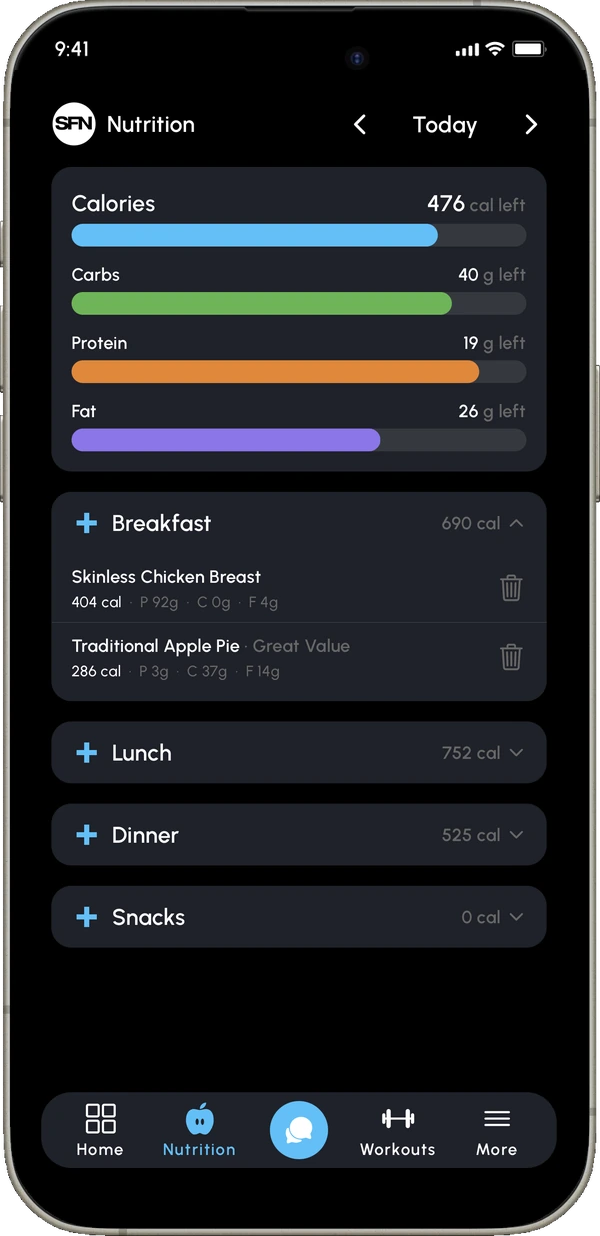
Somatics keeps your calories, carbs, protein and fat in one place, so you can see how close you are to your targets every day.
How to use this list
An easy way to eat more fiber is to add one food from this list to each meal: berries with breakfast, beans or lentils at lunch and a vegetable with dinner. Adding it over a week or two, with plenty of water, gives your stomach time to adjust.
Common questions
What food has the most fiber?
Beans and lentils lead the list. A cup of cooked navy beans has about 19 grams, and lentils, split peas and black beans have about 15 to 16. For a small serving, chia seeds have about 10 grams in 1 oz (28 g).
Does fiber count as carbs?
Yes. On U.S. nutrition labels, fiber is part of total carbohydrates, and most tracking apps count it that way too.
For more on fiber and the other nutrients in food, see What are macros?
Looking for a different list?
General information, not medical advice. If you have a food allergy or a health condition, go with what your doctor recommends.
Track macros and calories
with Somatics