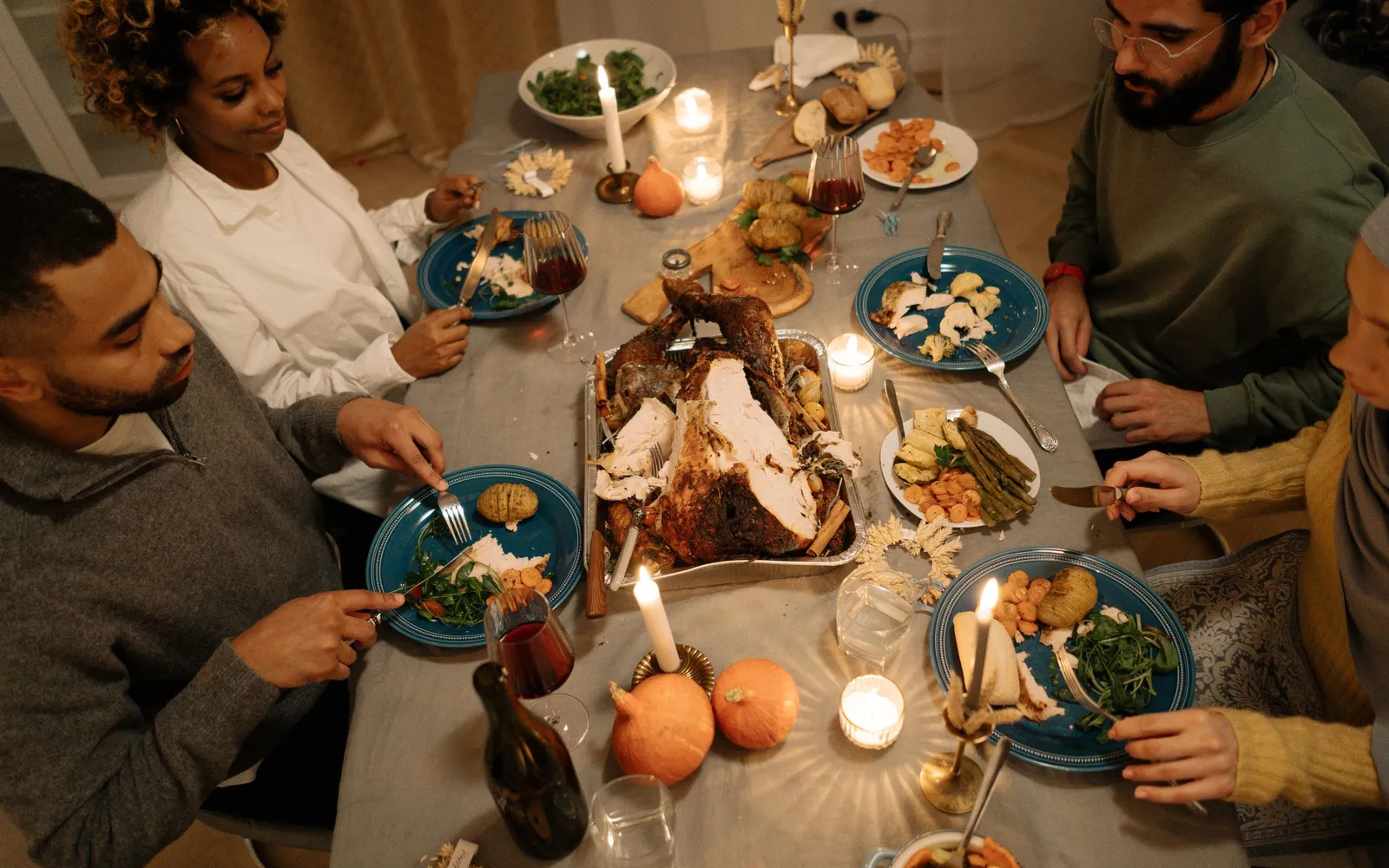
One plate of Thanksgiving dinner has about 1,300 calories: turkey, stuffing, mashed potatoes, gravy, cranberry sauce, green bean casserole and a buttered roll. A slice of pumpkin pie brings it to about 1,600, and seconds and a couple of drinks can push the meal past 2,300. We took every number from FoodData Central, the USDA's food database.
Calories in Thanksgiving foods
Your family's recipes will differ, so use these numbers as a starting point. We used stuffing from a boxed mix, canned gravy, and mashed potatoes made with whole milk and butter.
Turkey, sides and bread
| Food | Serving | Calories | Protein |
|---|---|---|---|
| Turkey, white meat with skin | 4 oz (113 g) | 200 | 33 g |
| Turkey, dark meat with skin | 4 oz (113 g) | 233 | 31 g |
| Ham, roasted | 3 oz (85 g) | 151 | 19 g |
| Stuffing | 1 cup (200 g) | 390 | 5 g |
| Mashed potatoes | 1 cup (210 g) | 237 | 4 g |
| Macaroni and cheese | 1 cup (230 g) | 513 | 20 g |
| Candied sweet potatoes | 1 piece, 2½ inches (105 g) | 172 | 1 g |
| Green bean casserole | 1 cup (230 g) | 129 | 5 g |
| Green beans, plain | 1 cup (125 g) | 44 | 2 g |
| Turkey gravy | ¼ cup (60 g) | 31 | 2 g |
| Cranberry sauce | ¼ cup (69 g) | 110 | 1 g |
| Dinner roll | 1 roll (28 g) | 87 | 3 g |
| Butter | 1 tbsp (14 g) | 102 | 0 g |
Pie and drinks
| Food | Serving | Calories | Protein |
|---|---|---|---|
| Pumpkin pie | ⅛ of a 9-inch pie (155 g) | 316 | 7 g |
| Apple pie | ⅛ of a 9-inch pie (155 g) | 411 | 4 g |
| Pecan pie | ⅛ of a 9-inch pie (122 g) | 503 | 6 g |
| Whipped cream, from a can | ¼ cup (15 g) | 39 | 0 g |
| Red wine | 5 fl oz glass (147 g) | 125 | 0 g |
| Beer | 12 fl oz can (356 g) | 153 | 2 g |
| Eggnog | 1 cup (254 g) | 224 | 12 g |
Our Food Directory lists calories and protein for the foods you eat the rest of the year.
How many calories are in a plate of Thanksgiving dinner?
A full plate with one serving of each main dish adds up to 1,286 calories:
| On the plate | Calories | Protein |
|---|---|---|
| 4 oz (113 g) white meat turkey with skin | 200 | 33 g |
| 1 cup (200 g) stuffing | 390 | 5 g |
| 1 cup (210 g) mashed potatoes | 237 | 4 g |
| ¼ cup (60 g) gravy | 31 | 2 g |
| ¼ cup (69 g) cranberry sauce | 110 | 1 g |
| 1 cup (230 g) green bean casserole | 129 | 5 g |
| 1 dinner roll with 1 tbsp butter | 189 | 3 g |
| Total | 1,286 | 53 g |
Add a slice of pumpkin pie with whipped cream and you're at about 1,640 calories. With two glasses of red wine, you reach about 1,890. If you also go back for half a plate of turkey, stuffing, potatoes and gravy, the meal comes to about 2,320.
You may have seen a bigger number: 3,000 calories for the meal, or 4,500 for the whole day. That figure comes from the Calorie Control Council, a trade group for companies that make low-calorie foods and sweeteners. The council doesn't say how it got the number.
You can eat more than our example in one sitting. In a 2020 study, young men ate pizza until they couldn't eat another bite. They took in about 3,100 calories in one sitting, twice what they ate when they stopped at comfortably full.
Which Thanksgiving foods have the most calories?
Per serving, macaroni and cheese (513 calories a cup) and pecan pie (503 a slice) top the list. Apple pie (411 a slice) and stuffing (390 a cup) come next. Butter adds about 100 calories a tablespoon, on a roll or in the potatoes.
Turkey gives you the most protein for its calories. On the plate above, 4 oz (113 g) of white meat brings 33 of the meal's 53 grams of protein for 200 calories. Dark meat has a little less protein and a little more fat. Plain green beans have about a third of the calories of green bean casserole, at 44 a cup.
For how much protein to aim for in a day, see How much protein do I need?
What happens after one big meal?
Expect the scale to jump the morning after. Some of that is food still in your gut, and carbs make your body store extra water. A 2022 review found that athletes gained about 2 to 3 lb (1 to 1.5 kg) over a few days of high-carb eating. Most of that was water, and their body fat didn't go up.
In a 2019 study, men ate 50% more than they needed for one day. The next day, they were as hungry as usual and ate about the same amount. Your appetite won't make up for a big meal on its own, so go back to your normal meals and your normal target the next day.
How much weight do people gain over the holidays?
Most studies find a small gain, but some of it tends to stay:
- A 2019 U.S. trial followed adults from before Thanksgiving to after New Year's Day. The group that kept their usual routine gained about 5.8 lb (2.65 kg). Fourteen weeks later, they still had about 3.3 lb (1.51 kg) of it. That gain is bigger than most other studies found.
- A 2018 U.K. trial over Christmas found a gain of about 0.8 lb (0.37 kg) in the group that got no advice.
- A 2020 study of 1,062 adults who had lost weight in the past year found that weight rose about 1.35% over Christmas. Two months into the new year, part of it was still there.
In both trials, weighing often helped. In the U.S. trial, adults who weighed themselves every day and saw their results didn't gain over the holidays. In the U.K. trial, regular weigh-ins plus a few tips cut the gain by about 1 lb (0.49 kg). A 2025 review of holiday programs found a similar benefit, but the authors rated their confidence in it as very low.
How to enjoy Thanksgiving dinner and stay on track
- Start with turkey and vegetables. Turkey brings the most protein for its calories, and plain vegetables have some of the fewest. That leaves you room for the dishes you get once a year.
- Pick the pie you want most. A slice of pecan pie has about 190 more calories than a slice of pumpkin.
- Slow down. A 2018 review of 40 studies found that slower eating and more chewing led people to eat a little less. The effect was small.
- Count your drinks. A 2019 review found that people who drank alcohol with a meal ate about 80 more calories of food, on top of the calories in the drink. They didn't eat less to make up for it.
- Walk after dinner. A 2023 review found that a walk after a meal lowered the rise in blood sugar, and the sooner people walked, the bigger the effect.
If you're losing fat, plan Thanksgiving into your week and log what you eat. Our guide on how to count calories covers how to set a target and log your food.

Common questions
How many calories are in a slice of pumpkin pie?
About 316 calories for one-eighth of a 9-inch homemade pie (155 g). A ¼ cup of whipped cream from a can adds 39, for about 355 in all.
Is white or dark turkey meat better for protein?
White meat has a little more. With the skin on, 4 oz (113 g) of white meat has 33 grams of protein and 200 calories. The same amount of dark meat has 31 grams and 233 calories.
Which Thanksgiving sides have the fewest calories?
Plain green beans (44 calories a cup), gravy (31 calories per ¼ cup) and green bean casserole (129 a cup) are the lightest sides in our table. Stuffing and macaroni and cheese have the most.
Sources
- U.S. Department of Agriculture. FoodData Central: SR Legacy (2018) and Food and Nutrient Database for Dietary Studies (2021 to 2023).
- Calorie Control Council. Thanksgiving: the battle of the bulge (archived copy). (A trade group for low- and reduced-calorie food and drink makers.)
- Hengist A. et al. Physiological responses to maximal eating in men. British Journal of Nutrition (2020). (Disclosure: several authors have received funding or fees from food and drink companies.)
- Shiose K. et al. Muscle glycogen assessment and relationship with body hydration status: a narrative review. Nutrients (2022).
- Deighton K. et al. A single day of mixed-macronutrient overfeeding does not elicit compensatory appetite or energy intake responses but exaggerates postprandial lipaemia during the next day in healthy young men. British Journal of Nutrition (2019).
- Kaviani S. et al. Daily self-weighing to prevent holiday-associated weight gain in adults. Obesity (2019).
- Mason F. et al. Effectiveness of a brief behavioural intervention to prevent weight gain over the Christmas holiday period: randomised controlled trial. BMJ (2018). (Disclosure: one author has received unrelated grants from a medical device company.)
- Turicchi J. et al. Weekly, seasonal and holiday body weight fluctuation patterns among individuals engaged in a European multi-centre behavioural weight loss maintenance intervention. PLoS One (2020).
- Guerrero-Magaña D.E. et al. Interventions for the prevention of weight gain during festive and holiday periods in children and adults: a systematic review. Obesity Reviews (2025).
- Krop E.M. et al. Influence of oral processing on appetite and food intake: a systematic review and meta-analysis. Appetite (2018). (Disclosure: one author works for a chewing gum maker, which co-funded the research.)
- Kwok A. et al. Effect of alcohol consumption on food energy intake: a systematic review and meta-analysis. British Journal of Nutrition (2019).
- Engeroff T. et al. After dinner rest a while, after supper walk a mile? A systematic review with meta-analysis on the acute postprandial glycemic response to exercise before and after meal ingestion in healthy subjects and patients with impaired glucose tolerance. Sports Medicine (2023).