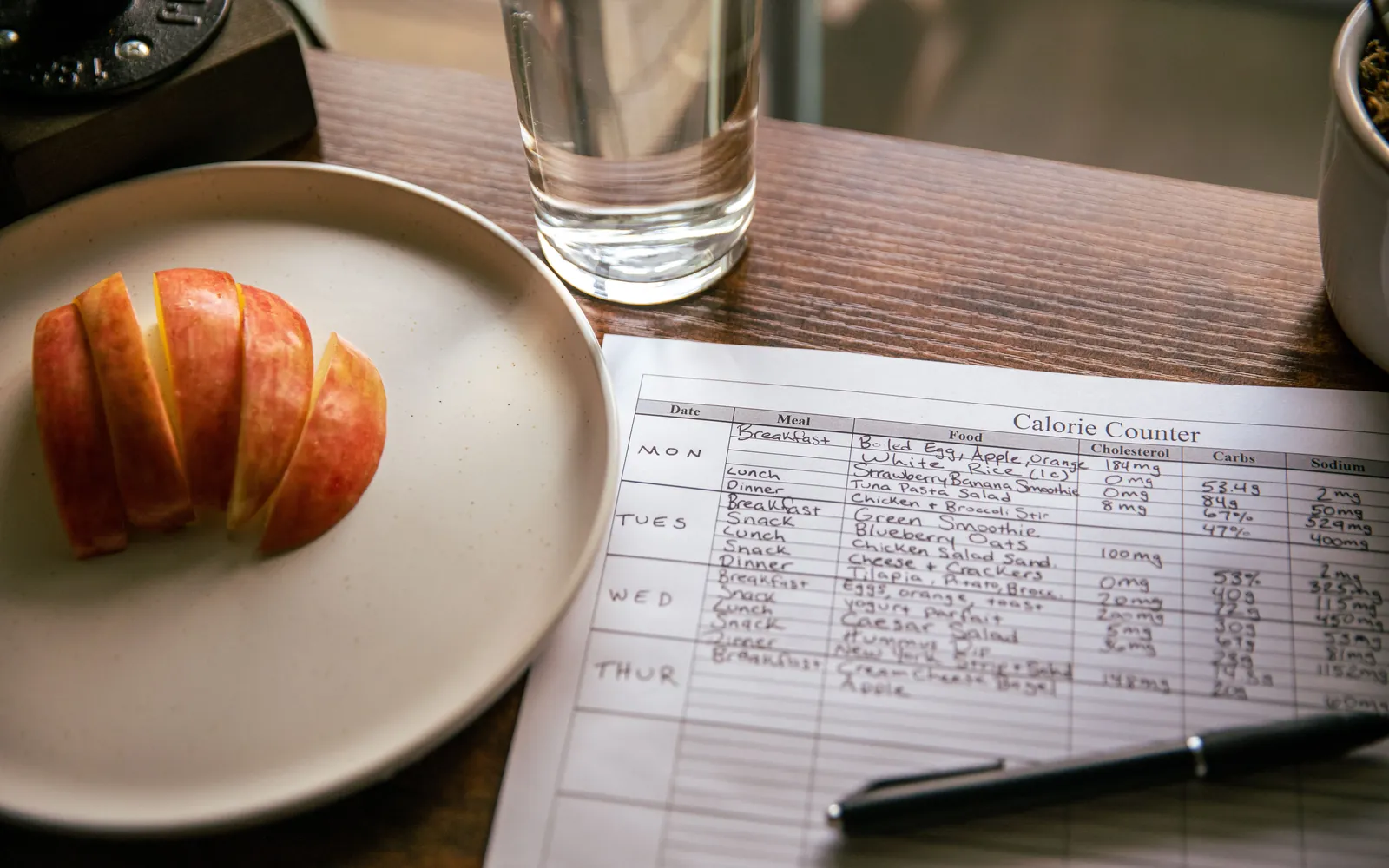
To count calories to lose weight, you set a daily target a little below what you burn, log everything you eat and drink, and check your average weight every couple of weeks. Setting the target is the easy part. Most mistakes happen when you log your food, so learning to log carefully gets you the best results.
Counting calories works because weight loss comes down to eating less energy than you use. When you write down what you eat, you can see where your calories come from and change the things that make the biggest difference.
Step 1: Set your calorie target
Start by estimating how many calories you burn in a normal day, then take off about 300 to 500. For most people, that leads to losing about 0.5 to 1% of their body weight a week, which is fast enough to see progress and slow enough to keep your energy up. For the full formula with a worked example, see How to calculate your macros, or let our free Macro, TDEE & BMR Calculator work out your number for you.
You may have heard that cutting 500 calories a day always adds up to a pound a week, because a pound of fat holds about 3,500 calories. That rule works for the first few weeks, but a study in The Lancet showed that it overestimates weight loss over time. As you get lighter, you burn fewer calories, so your progress slows down and you'll recalculate your target along the way.
Step 2: Pick an easy way to log
Pick a way of logging you'll keep up. A review of weight loss studies found that people who tracked their food consistently lost more weight than people who didn't. In another study, the people who logged most often lost the most weight, and by six months the average person was spending under 15 minutes a day on it.
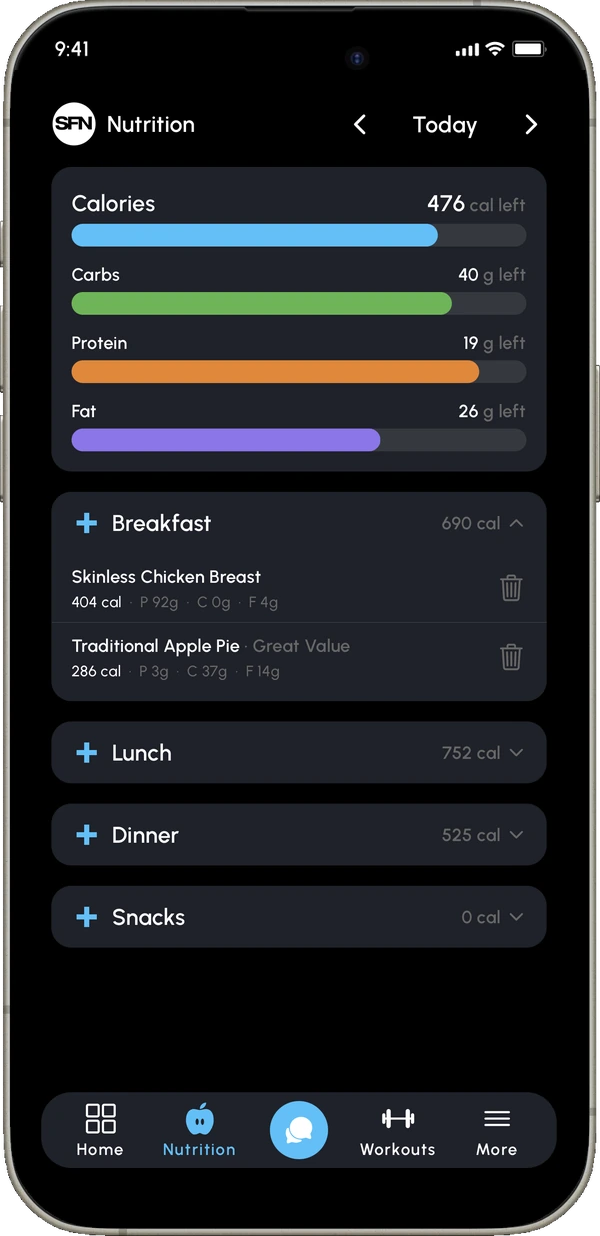
A food tracking app is the fastest option for most people. You can search for a food, scan the barcode on a package or save meals you eat often, so most entries take a few seconds. If a line on a package label is new to you, our Nutrition Label Guide goes through a real one part by part.
Step 3: Weigh your food for the first few weeks
A kitchen scale makes your tracking a lot more accurate. In a well-known study, people who said they couldn't lose weight on a low-calorie diet reported eating about 47% less than they actually ate, without realizing it. Most of that gap comes from guessing portions.
Foods that are easy to misjudge by eye include:
- Oils and nut butters, where an extra spoonful adds 100 calories or more
- Rice, pasta and cereal, where a "cup" often turns out to be two
- Cheese and nuts, which pack a lot of calories into a small handful
- Meat, where a "4 oz" piece of chicken might weigh 6 oz (170 g)
Weighing in grams is the most accurate. After a few weeks of weighing, you'll get much better at estimating, and you'll only pull out the scale now and then to check yourself.
Raw or cooked?
Food changes weight when you cook it. Meat loses water and gets lighter, so 4 oz (113 g) of raw chicken breast cooks down to about 3 oz (85 g). Rice and pasta soak up water and get heavier, so 1/4 cup (45 g) of dry rice becomes about 3/4 cup cooked. Either way works, as long as you weigh your food the same way the entry you pick describes it.
Step 4: Count the small stuff
The calories you're most likely to forget are in the oil in the pan, the dressing on the salad and the drinks between meals. These add up fast:
| Food or drink | Amount | Calories |
|---|---|---|
| Olive oil | 1 tbsp (15 ml) | About 120 |
| Butter | 1 tbsp (14 g) | About 100 |
| Mayonnaise | 1 tbsp (14 g) | About 95 |
| Ranch dressing | 2 tbsp (30 ml) | About 130 |
| Peanut butter | 2 tbsp (32 g) | About 190 |
| Shredded cheddar | 1/4 cup (28 g) | About 115 |
| Sweetened coffee creamer | 1 tbsp (15 ml) | About 35 |
| Regular soda | 12 fl oz (355 ml) | About 150 |
| Beer | 12 fl oz (355 ml) | About 150 |
| Wine | 5 fl oz (150 ml) | About 125 |
A splash of creamer in two coffees, oil for cooking dinner and a couple of drinks in the evening can come to 400 or 500 calories, which is the whole deficit for a lot of people.
How to count calories in homemade food
For a dish you cook often, like chili or a casserole, the most accurate way is to log it as a recipe:
- Weigh and log every ingredient as you add it, including the oil.
- When it's done, weigh the whole cooked dish.
- Divide the total calories by the total weight to get calories per gram or per ounce.
- Weigh your portion and log it.
It takes a few extra minutes the first time. After that, you can save it and log a serving in seconds whenever you make it again.
How to count calories when eating out
In the U.S., the FDA requires restaurant chains with 20 or more locations to list calories on their menus, so you can log those meals with a lot of confidence. For other restaurants, find a similar dish in your app and log it a little high. Restaurant cooks use more oil and butter than you'd use at home, so a small bump makes up for it.
A few habits help when you're eating out: ask for dressing and sauces on the side, keep an eye on the drinks, and don't stress about getting it perfect. One estimated meal won't change your weekly average much.
How to count food without a label
Fresh produce, meat from the butcher and food from a bakery or deli usually don't come with a label. Search for the plain version of the food, like "banana" or "chicken thigh, raw," and weigh it. Many apps include entries from the USDA's FoodData Central database, which lists nutrition numbers for thousands of basic foods.
What about calories burned from exercise?
Fitness trackers are a lot better at counting steps than calories. In one study, researchers tested seven popular wrist trackers and found that none of them measured calories burned within 20%, and some were off by much more. If you add your workout calories back to your target, it's easy to wipe out your deficit without noticing.
A simpler approach is to choose an activity level that already includes your workouts when you set your target, and leave the tracker's calorie number out of it.
Check your progress and adjust
Give it two to three weeks before you change anything. Weigh yourself a few mornings a week and compare weekly averages, because your weight can swing a few pounds from one day to the next from water alone. For more on that, see How much water is enough?
- If your weekly average is dropping about 0.5 to 1% a week, keep going.
- If it hasn't moved in three weeks, check your logging for missed extras first, then cut another 100 to 200 calories.
- If you're losing much faster and feel run down, add 100 to 200 calories.



Common questions
How many calories a day to lose a pound a week?
About 500 calories a day below what you burn, at least at the start. Your progress will slow as you get lighter, so expect to recalculate every 10 to 15 lb (4.5 to 7 kg).
Do I count calories forever?
No. You can count closely for a few months, learn what your usual portions look like, and then switch to tracking only protein, or to checking in for a week now and then.
Is it a problem if I go over my calories one day?
No. Your weekly average matters much more than any single day. Log it honestly and carry on with your plan the next day.
Do I count calories in vegetables?
Yes, though they rarely change your total by much. Leafy greens and most non-starchy vegetables are very low in calories. The oil, butter or dressing you put on them is worth logging carefully.
Is counting calories or macros better?
Your calorie total controls whether you lose weight, and your macros, especially protein, affect how much of what you lose is fat instead of muscle. Most food apps track both at once. To see how much protein to aim for, see How much protein do I need a day?
Sources
- Hall K.D. et al. Quantification of the effect of energy imbalance on bodyweight. The Lancet (2011).
- Lichtman S.W. et al. Discrepancy between self-reported and actual caloric intake and exercise in obese subjects. New England Journal of Medicine (1992).
- Burke L.E. et al. Self-monitoring in weight loss: a systematic review of the literature. Journal of the American Dietetic Association (2011).
- Harvey J. et al. Log often, lose more: electronic dietary self-monitoring for weight loss. Obesity (2019).
- Shcherbina A. et al. Accuracy in wrist-worn, sensor-based measurements of heart rate and energy expenditure in a diverse cohort. Journal of Personalized Medicine (2017).
- U.S. Food and Drug Administration. Menu labeling requirements.
- U.S. Department of Agriculture. FoodData Central.