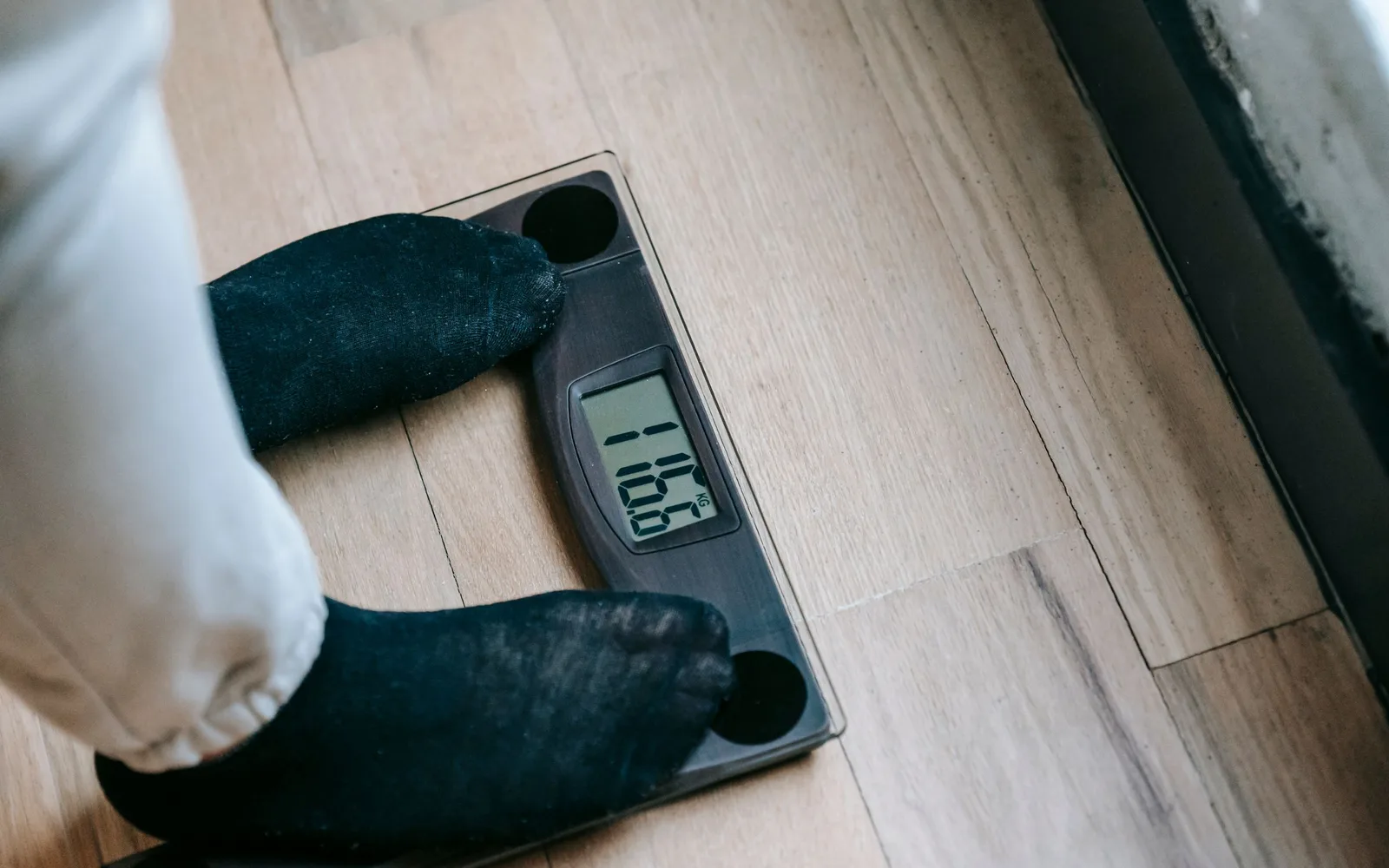
The scale can show a few pounds more than yesterday, but very little of that is fat. To store 1 lb of fat, you'd have to eat about 3,500 calories more than you burn, and that's hard to do in one day. Most overnight jumps come from water, carbs, salt and food that's still in your gut, and they usually fade within a few days once you're back to your normal meals.
How much fat can you gain in one day?
One kilogram of body fat stores about 7,700 calories, according to a 2021 review, which works out to about 3,500 calories per pound. Fat tissue holds some water too, which is why that number is lower than pure fat.
Even if your body stored every extra calorie as fat, this is the most you could add in a day:
| Calories over maintenance | Most fat you could gain |
|---|---|
| 500 | About 0.15 lb (0.07 kg) |
| 1,000 | About 0.3 lb (0.13 kg) |
| 1,500 | About 0.4 lb (0.2 kg) |
| 3,000 | About 0.9 lb (0.4 kg) |
Your body burns some of the extra food as heat and stores some as glycogen, so the real number is usually lower. And you can only eat so much in one day. In a 2020 study, 14 men kept eating pizza well past full, until they couldn't fit in any more. They averaged about 3,100 calories in that one meal, about twice their intake when they stopped at comfortably full.
So if you see 4 lb more on the scale after a big day, maybe half a pound of it could be fat. The rest is water and food that will come back off.
Why the scale jumps overnight
Most of the common reasons come down to water:
| Cause | How much it can add | Is it fat? |
|---|---|---|
| A high-carb day or a few days of them | About 2 to 3 lb (1 to 1.5 kg) across several days | No, mostly water |
| A lot of salt for several days | About 5.5 lb (2.5 kg) after 8 days in one study | No, mostly water |
| Food still in your gut | Varies with how much you ate | No |
| Your period | About 1 lb (0.45 kg) | No, water |
| Starting creatine | About 2 to 6.5 lb (1 to 3 kg) on a high starting dose | No, mostly water |
| Weekends | About 0.5 lb (0.25 kg) at 180 lb | Some can be, if you eat more |
Carbs and glycogen
Your muscles store carbs as glycogen, and glycogen pulls water in with it. A 2023 review put it at about 3 to 4 grams of water for every gram of glycogen in muscle, though the authors noted the exact ratio isn't settled. Athletes who load up on carbs before a race usually put on about 2 to 3 lb (1 to 1.5 kg) during the loading days, mainly from that water.
The same thing happens after pizza, pasta or dessert. It also works the other way, which is why you can drop weight fast in the first week of a low-carb diet and then slow down.
Salt
Your body holds on to water to balance extra sodium. In a 2020 trial, 12 healthy men ate either more than 12 g of salt a day (about 4,700 mg of sodium) or less than 3 g for 8 days each. They weighed about 5.5 lb (2.5 kg) more on the high-salt diet.
A smaller change may not show up at all. In a 2022 trial, adding 6 g of salt a day for 2 weeks didn't make a clear difference in body weight or body water. So a salty restaurant meal can bump the scale, but a normal amount of salt probably isn't what's moving it day to day.
Food in your gut
A 2023 review found that food takes about 28 hours on average to pass all the way through your gut, and that time varies a lot between people and from day to day. So the weight of yesterday's meals, plus the water in them, is often still with you the next morning, especially after a big dinner.
Your period
In a 2023 study of 42 women measured twice a week across one cycle, weight was about 1 lb (0.45 kg) higher during their period than in the first week of the cycle. The extra weight matched an increase in body water, and their body fat didn't change.
Creatine
Creatine pulls water into your muscles. A 2021 review found that people who took a high starting dose of 20 g a day for 5 to 7 days usually gained about 2 to 6.5 lb (1 to 3 kg), mostly water, and that creatine doesn't add fat. See how much creatine to take a day.
Weekends
Most people weigh a little more at the start of the week. In a 2023 study, 368 adults weighed themselves on smart scales for about a year. Their weight swung by about 0.3% each week, highest on Monday and Tuesday and lowest by Friday. At 180 lb, that's about half a pound. A 2020 study of about 1,400 adults found a similar weekly swing of about 0.35%.
Holidays can push the scale up more. Our post on how many calories are in Thanksgiving dinner covers what happens after a big holiday meal.
How to weigh yourself so the number means something
A few habits make the swings easier to read:
- Weigh at the same time every day. First thing in the morning, after the bathroom and before you eat or drink, is the easiest time to keep the same.
- Use the same scale on the same spot, in the same clothes or none.
- Compare weekly averages, not single days. Add up the week's weigh-ins, divide by how many you did, and compare that number with last week's.
- Watch your waist and your lifts too. If your waist is going down and you're getting stronger, a high reading on the scale doesn't mean much.
Weighing yourself most days may help you keep weight off, if you stick with it. In a 2020 study of 74 adults who had lost weight, the people who weighed themselves 6 or 7 days a week, week after week, regained less over 9 months. It was a small study, and it can only show a link.
Daily weighing isn't for everyone, though. In a 2023 trial, young women who weighed themselves every day for 2 weeks had bigger mood swings and felt worse about their bodies than women who took their temperature every day instead. If the daily number stresses you out, weigh a few times a week, or only look at the weekly average.
When is the gain real?
A jump that's gone in 2 or 3 days was mostly water. If your weekly average keeps going up for 2 weeks or more, you're probably eating more than you burn. That's fine if you're bulking. If you're trying to lose fat, check how much you're eating. Our post on why you're not losing weight in a calorie deficit walks through the common reasons.
If you gain weight fast along with swelling in your legs or ankles, or trouble breathing, talk to your doctor.
When you log your food, you can see why the scale moved. If yesterday had extra carbs or a salty dinner, a higher number this morning makes sense.


Common questions
Why do I weigh more after a cheat day?
It's mostly water and food. Big meals tend to be high in carbs and salt, which both make your body hold water, and the food itself is still in your gut. Even a 1,500-calorie surplus could add only about 0.4 lb of fat at most.
How long does water weight last after a big meal?
Usually a few days once you go back to your normal meals. If you stay heavier on your weekly average for 2 weeks or more, some of it is likely real gain.
Should I weigh myself every day?
It can help if you look at the weekly average and the number doesn't bother you. If it makes you anxious, a few times a week is fine. Weighing the same way each time matters most.
Why do I weigh more at night than in the morning?
By the evening, you've eaten and drunk for the whole day, and a lot of it is still in your body. Overnight, you breathe out water and use the bathroom in the morning, so your weight drops. That's why morning weigh-ins are easier to compare.
Can you lose 5 lb in a day?
On the scale, sometimes, but it's almost all water and food leaving your body. To lose 1 lb of fat, you'd need to burn about 3,500 more calories than you eat.
Sources
- Kolnes K.J. et al. Effect of Exercise Training on Fat Loss: Energetic Perspectives and the Role of Improved Adipose Tissue Function and Body Fat Distribution. Frontiers in Physiology (2021).
- Hengist A. et al. Physiological responses to maximal eating in men. British Journal of Nutrition (2020). (Disclosure: several authors have received funding or fees from food and drink companies.)
- Shiose K. et al. Muscle Glycogen Assessment and Relationship with Body Hydration Status: A Narrative Review. Nutrients (2023).
- Wenstedt E.F.E. et al. Effect of high-salt diet on blood pressure and body fluid composition in patients with type 1 diabetes: randomized controlled intervention trial. BMJ Open Diabetes Research and Care (2020).
- Mähler A. et al. Increased Salt Intake Decreases Diet-Induced Thermogenesis in Healthy Volunteers: A Randomized Placebo-Controlled Study. Nutrients (2022).
- Procházková N. et al. Advancing human gut microbiota research by considering gut transit time. Gut (2023).
- Kanellakis S. et al. Changes in body weight and body composition during the menstrual cycle. American Journal of Human Biology (2023). (Disclosure: one author lists a nutrition company affiliation.)
- Antonio J. et al. Common questions and misconceptions about creatine supplementation: what does the scientific evidence really show? Journal of the International Society of Sports Nutrition (2021). (Disclosure: several authors have ties to creatine makers and sellers.)
- Maher C. et al. Weekly, Seasonal, and Festive Period Weight Gain Among Australian Adults. JAMA Network Open (2023).
- Turicchi J. et al. Weekly, seasonal and holiday body weight fluctuation patterns among individuals engaged in a European multi-centre behavioural weight loss maintenance intervention. PLOS ONE (2020).
- Brockmann A.N. et al. Frequency and Consistency of Self-Weighing to Promote Weight-Loss Maintenance. Obesity (2020).
- Pacanowski C.R. et al. Daily self-weighing compared with an active control causes greater negative affective lability in emerging adult women: A randomized trial. Applied Psychology: Health and Well-Being (2023).