If you're trying to gain weight or build muscle, eating enough can be the hard part. Foods that pack a lot of calories into a small serving, like nuts, nut butters, olive oil, avocado, granola and dried fruit, make it easier to eat more without feeling stuffed. Pairing them with high-protein foods like steak, salmon and eggs covers your protein too.
Food Directory



Track macros and calories
High-Calorie Foods
Healthy, calorie-dense foods that make it easier to eat more, with the calories and macros for a normal serving of each.
Sort by
| Food | Calories | Protein | Carbs | Fat | Fiber |
|---|---|---|---|---|---|
| Ribeye steak, broiled6 oz (170 g) | 450 | 45.2 g | 0 g | 28.5 g | 0 g |
| Salmon, cooked6 oz (170 g) | 350 | 37.6 g | 0 g | 21 g | 0 g |
| Ground beef (80%), cooked4 oz (113 g) | 305 | 29.1 g | 0 g | 20.1 g | 0 g |
| Chicken thigh, skinless, roasted4 oz (113 g) | 202 | 28 g | 0 g | 9.2 g | 0 g |
| Eggs, hard-boiled3 large (150 g) | 232 | 18.9 g | 1.7 g | 15.9 g | 0 g |
| Cheddar cheese1 oz (28 g) | 116 | 6.9 g | 0.6 g | 9.6 g | 0 g |
| Whole milk1 cup (240 ml) | 149 | 7.7 g | 11.7 g | 7.9 g | 0 g |
| Peanut butter2 tbsp (32 g) | 191 | 7.1 g | 7.1 g | 16.4 g | 1.6 g |
| Almond butter2 tbsp (32 g) | 196 | 6.7 g | 6 g | 17.8 g | 3.3 g |
| Almonds1 oz, about 23 almonds (28 g) | 164 | 6 g | 6.1 g | 14.2 g | 3.5 g |
| Walnuts1 oz, about 14 halves (28 g) | 185 | 4.3 g | 3.9 g | 18.5 g | 1.9 g |
| Cashews, dry roasted1 oz (28 g) | 163 | 4.3 g | 9.3 g | 13.1 g | 0.9 g |
| Macadamia nuts1 oz (28 g) | 204 | 2.2 g | 3.9 g | 21.5 g | 2.4 g |
| Trail mix¼ cup (38 g) | 173 | 5.2 g | 16.8 g | 11 g | n/a |
| Olive oil1 tbsp (14 g) | 119 | 0 g | 0 g | 13.5 g | 0 g |
| Avocado1 whole (201 g) | 322 | 4 g | 17.1 g | 29.5 g | 13.5 g |
| Dark chocolate (70-85%)1 oz (28 g) | 170 | 2.2 g | 13 g | 12.1 g | 3.1 g |
| Granola½ cup (61 g) | 298 | 8.3 g | 32.9 g | 14.8 g | 5.4 g |
| Oats, dry1 cup (81 g) | 307 | 10.7 g | 54.8 g | 5.3 g | 8.2 g |
| Whole-wheat bagel1 bagel, 4 in (98 g) | 245 | 10 g | 47.9 g | 1.5 g | 4 g |
| Brown rice, cooked1 cup (202 g) | 248 | 5.5 g | 51.7 g | 2 g | 3.2 g |
| Whole-wheat bread2 slices (64 g) | 161 | 8 g | 27.3 g | 2.2 g | 3.8 g |
| Raisins¼ cup (41 g) | 123 | 1.4 g | 32.5 g | 0.1 g | 1.8 g |
| Medjool dates3 dates (72 g) | 199 | 1.3 g | 54 g | 0.1 g | 4.8 g |
| Banana1 medium (118 g) | 105 | 1.3 g | 27 g | 0.4 g | 3.1 g |
| Sweet potato, baked1 cup (200 g) | 180 | 4 g | 41.4 g | 0.3 g | 6.6 g |
No foods match that search.
Nutrition numbers come from the USDA's FoodData Central database, for the serving size shown. Packaged foods vary by brand, so check the label for exact numbers.
Need an app to track your calories?
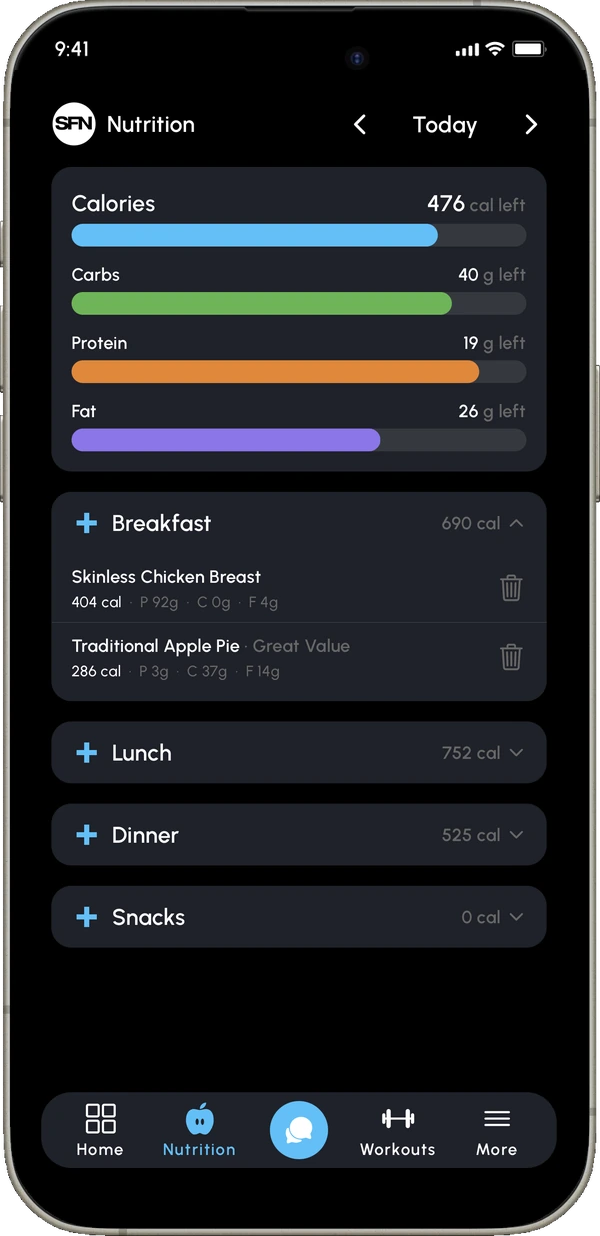
Somatics keeps your calories, carbs, protein and fat in one place, so you can see how close you are to your targets every day.
How to use this list
A small calorie surplus, about 300 calories a day over what you burn, is a common starting point for building muscle while keeping fat gain low. Our free Macro, TDEE & BMR Calculator estimates that number for you. Easy ways to add calories are a spoonful of nut butter in your oats, olive oil on your vegetables, a handful of nuts or trail mix as a snack, or a glass of whole milk with a meal.
Common questions
What's the healthiest way to gain weight?
Most people do it by eating a little more than they burn, with most of it from whole foods, while lifting weights so more of what they gain is muscle. A common pace is about 0.25 to 0.5% of your body weight a week. See How to bulk: eating in a calorie surplus to build muscle.
Which foods have the most calories for their size?
Fat has 9 calories per gram, compared with 4 for protein and carbs, so oils, nuts, nut butters and avocado pack a lot of calories into a small amount, and dried fruit like dates and raisins has more calories than the same amount of fresh fruit.
For full days at higher calories, see our 2,500 and 3,000 Calorie Meal Plan Examples.
Looking for a different list?
General information, not medical advice. If you have a food allergy or a health condition, go with what your doctor recommends.
Track macros and calories
with Somatics